
Read Part 1: The High-Stakes World of Retail Options Trading
Pillar Foundations
The surge in retail participation in options trading has revealed a significant disconnect between market accessibility and trader preparedness. While digital platforms have democratized entry to these markets, many individual traders lack the skills to effectively manage the complexities and risks of derivatives trading (Keller & Strohmenger, 1989; Smith & Spiegel, 2016). To bridge this gap, SmartOptions presents a unique three-pillar framework: Education, Execution, and Evaluation. This comprehensive framework builds trading competency, mitigates behavioral biases, and ensures alignment between trading activities and broader financial objectives. The framework addresses key trader needs through:
- Education: Empowering users through gamified learning modules and interactive simulations that enhance concept retention and strategic thinking
- Execution: Utilizing advanced real-time analytics and proprietary SmartEngine technology to optimize trade placement and reduce hidden costs
- Evaluation: Delivering personalized insights by synthesizing risk profiles, behavioral patterns, and portfolio context to facilitate continuous improvement
 Pillar 1: Education
Options trading involves multi-dimensional considerations, including expiry dates, strike prices, volatility, time decay, and the interplay of the Greek alphabets (Delta, Gamma, Theta, Vega). Numerous strategies (e.g., spreads, straddles, strangles) carry unique risk-reward profiles (Keller & Strohmenger, 1989). Traditional finance education materials often present these concepts in isolation, failing to accommodate the hands-on practice and corrective feedback needed for novice learners (Smith & Spiegel, 2016)..
Gamification
Gamification, a strategic approach to learning that has gained significant traction across various disciplines, offers promising avenues for enhancing user engagement and knowledge retention in financial education, specifically in option trading. As defined by Kapp (2012) and Werbach (2014), gamification is a transformative process that makes learning more engaging and effective. It involves implementing game-based elements, mechanics, and thinking processes in non-game contexts to increase participant engagement, motivate action, and facilitate learning outcomes. This transformative effect on conventional learning experiences is a source of inspiration and optimism for the future of financial education.
The core framework of gamification encompasses five fundamental components that Nah et al. (2013) identified. These components, including goal orientation, achievement mechanisms, reinforcement systems, competitive structures, and fun orientation, are crucial in creating a successful gamified learning experience.
- Goal orientation, establishing clear objectives for learners
- Achievement mechanisms providing experiences of success
- Reinforcement systems respond to specific behaviors and outcomes.
- Competitive structures motivating performance improvement
- Fun orientation, reducing learning stress while enhancing engagement
Mobile applications in financial education present substantial opportunities to incorporate these elements effectively across cognitive, emotional, and behavioral dimensions of user engagement. Gamification impacts multiple dimensions of user engagement in financial education:
- Cognitive Engagement: Presenting complex financial concepts in accessible formats through progressive challenges and interactive problem-solving (Hamari et al., 2016)
- Emotional Engagement: Generating positive emotional responses through reward systems and achievement recognition, correlating with increased persistence (Sailer & Homner, 2020)
- Behavioral Engagement: Improving observable learning behaviors through structured participation requirements and interactive elements (Dicheva et al., 2015)
SmartOptions will reinforce user expertise by awarding badges as users progress through increasingly complex strategies. To earn each badge, users must demonstrate successful strategy implementation, consistent repeatability, and mastery through educational quizzes as well as both paper and live trading performance. SmartOptions will offer the following Strategy Badge Levels:
- Basic: Long Call, Long Put, Covered Calls, Protective Puts
- Intermediate: Covered Roll-outs, Buy-Writes & Unwinds, Straddle, Strangle
- Advanced: Calendar Spreads, Vertical Spreads, Iron Condor, Butterfly Spread
- Expert: Short Call, Short Put, Ratio Spreads, Box Spreads, Diagonal Spreads
Financial education platforms implementing gamification strategies demonstrate measurable improvements in key metrics, including session duration, return frequency, and completion rates (Looyestyn et al., 2017). However, integrating artificial intelligence with gamification elements offers additional potential for personalization. This means that the framework can adapt difficulty levels and content presentation to individual user performance and learning patterns, providing reassurance about its adaptability and effectiveness (Kim et al., 2018).
Duolingo: A Case Study
Duolingo highlights the power of gamification in education with its 12-month retention rate of 68% far surpassing the 10–20% typical found in traditional courses (Vesselinov & Grego, 2016). Duolingo’s success stems from its comprehensive application of gamification mechanisms, including progressive skill paths, rewards systems, and social competition. Gamification, especially when enhanced with AI, boosts engagement, knowledge retention, and learning outcomes in options trading education. Duolingo’s platform implements comprehensive gamification through several key mechanisms:
- Progressive Skill Development: Duolingo’s skill tree model, which unlocks lessons progressively, can similarly structure options trading education from foundational to advanced concepts.
- Consistent Streak Incentives: Daily streak counters that reward consistent engagement can be adapted to encourage regular practice of trading strategies and reinforce habits.
- Risk-Free Experimentation: Like Duolingo’s use of virtual “Lingots” currency, simulated trading environments allow users to practice and refine strategies without financial risk.
- Personalized Learning Paths: AI-driven adaptive learning keeps lessons at the right difficulty level; in options education, AI can tailor content and challenges to a trader’s evolving skill set.
- Community and Leaderboards: Experience Points (“XP” systems and peer competition boost engagement and knowledge sharing, driving 45% more lesson completions (Settles & Meeder, 2016).
- Immediate Feedback Loops: Providing instant feedback on correct and incorrect decisions reinforces learning and builds trader confidence through actionable insights.
Duolingo has firmly established itself as a global leader in online education, consistently delivering exceptional user engagement, financial growth, and technological innovation that outpaces competitors like Babbel. Its rapid expansion in users and revenue offers a compelling model for SmartOptions to achieve similar market traction. By emulating Duolingo’s user-centric growth strategies, SmartOptions can accelerate adoption, build a strong brand presence, and set itself on a path toward significant user scale and a high-value IPO.
Key Highlights:
- Market Position: Duolingo is a publicly traded company (NASDAQ: DUOL) with a market cap of approximately $17.3 billion as of April 2025. Its closest competitor, Babbel, holds an estimated valuation of $262.6 million (Stock Analysis, 2025; Medium, 2023).
- User Growth and Engagement: By the end of 2024, Duolingo reached 500 million registered users, 116.7 million monthly active users (MAUs) and over 40 million daily active users (DAUs), with its paid subscriber base growing 43% to 9.5 million users (Duolingo, 2024; Barron’s, 2025).
- Financial Performance: Duolingo generated $748 million in annual revenue in 2024, a 41% year-over-year increase, and achieved $88.6 million in net income, up from $12.1 million the previous year (Barron’s, 2025).
Note: Adapted from: Duolingo. (2023). Duolingo efficacy whitepaper
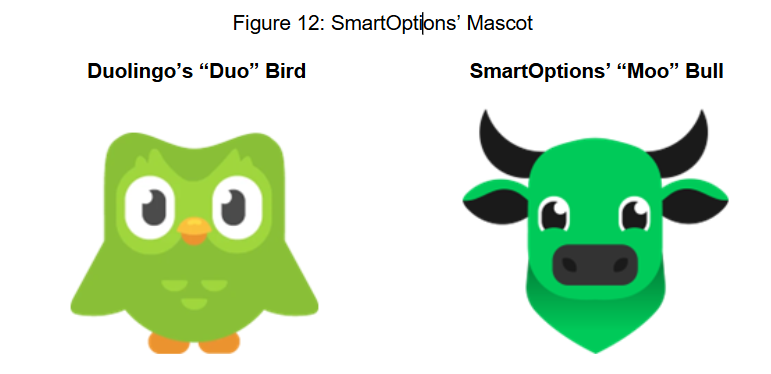
The first step in replicating Duolingo’s success is developing a memorable brand mascot, similar to Duolingo’s iconic bird, Duo. SmartOptions will introduce “Moo,” a bull character whose name is short for “Momentum.” Moo embodies a bullish spirit, playfulness, approachability, and a relentless drive for growth, reflecting SmartOptions’ commitment to helping users succeed and continually move forward.
Pillar 2: Execution
Inflated Spreads
Retail traders overlook significant indirect trading costs, highlighted by an average quoted bid-ask spread of 12.6%, contributing to their losses especially considering the standard contract size of 100 shares and high frequency of trades per year. Slightly out-of-the-money options carry even higher trading costs at an average bid-ask spread of 29%. Additionally, nearly half of retail trades are small (under $250) with high spreads of 23.5%. Wide spreads in effect make cheaper options expensive to trade (Bryzgalova, 2023).
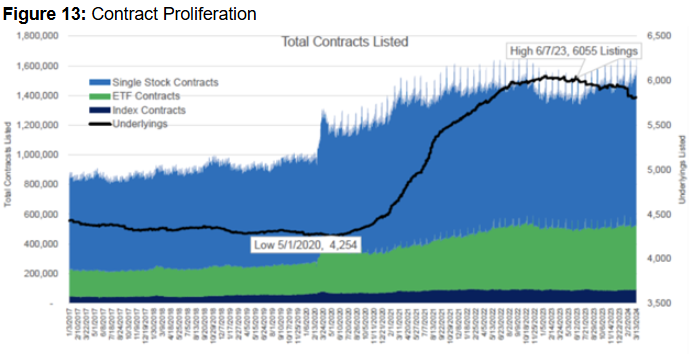
Inflated spreads on options can be attributed to a number of factors with contract proliferation and illiquidity being the main contributors. Compared to equities, the options market is inherently less liquid and more fragmented, causing spreads to be much wider than for stocks. Figure 13 shows that the number of option classes has grown from 4,000 to nearly 6,000, with over 1.5 million contracts listed and the number of strikes nearly doubling. Although many options remain inactive, exchanges are still required to list and update prices for roughly 30% of single-stock, 50% of index, and 60% of ETF option strikes that have no open interest, creating significant strain on system capacity (Acworth, 2024). Liquidity is therefore spread thin, leading to less competition, and market makers posting wider spreads to compensate for more risk, especially for highly volatile thinly traded companies. Also, since options often trade at low prices, even small bid-ask spreads can look big in percentage terms. A $0.10–$0.20 spread on a $1.00 option is just several cents, but that still translates to a 10–20% spread.
Note: Adapted from: Acworth, W. (2024, May 14). US options industry leaders wrestle with constraints on growth. Futures Industry Association.
Wide spreads equate to extremely large trading costs. The total trading costs, calculated as the difference between actual trade prices and the prevailing mid-quote, reached an astonishing $6.4 billion in 2021. This figure far exceeds the direct costs of trading, which are approximately $900 million based on retail brokerage commissions (Bryzgalova, 2023). It is therefore surprising how active retail investors are in the options trading market considering their aggregate losses and higher transaction costs compared to equities. Regulatory agencies should require brokerages to properly disclose these high execution costs as well as provide more transparency in wholesaler PFOF activities.
SmartEngine
SmartOptions has a unique opportunity to help retail investors overcome significant execution disadvantages of wide bid-ask spreads, which often go unnoticed by retail traders due to a lack of tools and market visibility. To address this inefficiency, SmartOptions introduces SmartEngine, a real-time execution intelligence layer modeled after the functionality of Kayak.com. SmartEngine compares execution prices across multiple brokerages, surfacing the lowest-cost route for each individual options trade. By acting as an “execution optimizer” rather than a brokerage itself, SmartEngine enables retail traders to identify the tightest bid-ask spreads and route trades accordingly through their existing brokerage accounts.
From a product architecture perspective, SmartEngine connects directly to users’ brokerages, enabling smart routing without taking custody or execution responsibility, preserving regulatory compliance and user flexibility. Each trade routed through SmartEngine is evaluated against the best available market prices, with a post-trade scorecard showing users whether they achieved optimal execution and how much they saved compared to the quoted market average. Through seamless API integration, SmartEngine continuously collects real-time quotes, analyzes spread differentials, and delivers actionable insights to help users execute trades more efficiently.
SmartOptions’ performance-based pricing model, powered by SmartEngine, sets it apart from traditional commission structures and subscription-only services by delivering significant savings to users while generating sustainable revenue for the platform.
- User Savings: To illustrate, consider a frequent retail trader who executes approximately 100 trades per year, with each trade involving a notional value of $400. If SmartEngine helps compress the bid-ask spread from 12% to 4%, the total spread savings per trade would equate to $29, with $23.20 retained by the user. Based on 100 trades a year, that comes to $2,320 in annual user savings.
- Spread Capture: The SmartOptions platform captures 20% of the spread compression achieved per trade. Based on the User Savings example, SmartOptions would capture 20% of the $29 spread capture, or $5.80 per trade. Based on 100 trades a year, that comes to $580 in annual revenue from a single user.
Table 1 : SmartEngine’s Unit Economics
| Metric | Before SmartEngine | After SmartEngine |
| Bid Price (per contract) | $3.57 | $3.57 |
| Ask Price (per contract) | $4.00 | $3.71 |
| Bid-Ask Spread (per contract) | $0.43 | $0.14 |
| Spread % (based on Bid) | 12% | 4% |
| Total Cost at Ask (100 contracts) | $400 | $371 |
| Total Value at Bid (100 contracts) | $357 | $357 |
| Total Spread Cost (100 contracts) | $43 | $14 |
| Spread Savings (per trade) | – | $29 |
| SmartOptions Capture (20% of savings) | – | $5.80 |
| User Retains (80% of savings) | – | $23.20 |
| SmartOptions Capture Annually (100 trades) | – | $580 |
| User Savings Annually (100 trades) | – | $2,320 |
Note. From SmartOptions – conducted April 2025 by the SmartOptions Research Team
SmartEngine earns revenue only when it saves users money, aligning its incentives directly with trader outcomes rather than trading volume or controversial practices like payment for order flow. This performance-based model promotes transparency, trust, and ethical scalability, ensuring users retain most of their savings while SmartOptions profits only from tangible improvements, a rare alignment in financial platforms. By improving trade outcomes for retail investors and creating a high-margin revenue stream without relying on volume-based incentives, SmartOptions is uniquely positioned to disrupt the existing options trading landscape. SmartOptions seeks to make options trading not just smarter, but fundamentally fairer by returning lost value to the everyday trader.
Additionally, SmartEngine serves not just as an informational layer, but as an intelligent decision support system. Its core product features include an API-based execution scanner and a predictive visualization tool called the “Cone of Accuracy,” among others, which are discussed in greater detail in the upcoming “Product Function” section. Consistent with SmartEngine’s mission, these investing tools are designed to help retail traders achieve smarter, better-executed trades.
Pillar 3: Evaluation
The third pillar, Evaluation, integrates options trading within the broader context of a user’s financial portfolio, bridging the gap between tactical trade execution and strategic wealth management. Rather than treating options trading as an isolated activity, SmartOptions ensures each trading decision is evaluated through the lens of overall portfolio impact, fostering sustainable financial growth.
Grounded in Modern Portfolio Theory (Markowitz, 1952) and supported by empirical research on risk tolerance and behavioral biases (Grable & Lytton, 1999; Nobre & Grable, 2015). Risk tolerance refers to an individual’s willingness and ability to withstand fluctuations in portfolio value, and plays a pivotal role in determining suitable investment strategies (Grable & Lytton, 1999). The concept of “risk scoring” typically involves combining subjective questionnaire responses with objective financial metrics (e.g., net worth, time horizon, income stability) to produce a single score that guides portfolio decisions (Nobre & Grable, 2015). A higher score indicates greater capacity and willingness to accept volatility. The (FINRA) offers guidance on assessing personal risk tolerance, emphasizing that individual differences in behavior and attitudes often outweigh purely demographic indicators (FINRA, 2023).
SmartOptions uses an adaptive risk profiling system during user onboarding. Participants provide demographic, financial, and behavioral data, including income stability, investment horizon, risk preferences, and trading experience, which are synthesized to generate a personalized risk score and recommended portfolio allocation. Crucially, SmartOptions extends this traditional asset allocation framework by integrating open options positions into its dynamic evaluation, analyzing how strategies such as covered calls, long puts, or short straddles alter portfolio risk exposures. Sample onboarding questions include:
Table 2 : SmartEngine’s Onboarding Questionnaire
| Category | Details |
| Personal Info | Name, Age, Marital Status, Residence, Citizenship/Visa |
| Income Sources | Primary: Employment, Freelance
Secondary: Rentals, Dividends |
| Financial Goals | Short-Term: Home, Vacation, Debt Repayment
Mid-Term: Education, Business Long-Term: Retirement, Legacy Planning |
| Investment Experience | Beginner / Intermediate / Expert |
| Investment Horizon | Short-Term / Medium-Term / Long-Term |
| Market Outlook | Bullish / Bearish / Static |
| Risk Tolerance | Aggressive / Moderate / Conservative |
| Expenses | Fixed: Housing, Utilities, Loans
Variable: Groceries, Travel Discretionary: Hobbies, Luxury |
| Assets | Liquid: Cash, Savings
Investments: Stocks, Bonds, Real Estate |
| Liabilities | Short-Term: Credit Cards, Personal Loans
Long-Term: Mortgage, Auto Loans, Student Loans |
| Tax Status | Current Income Bracket |
Note. Adapted from OpenAI (2024)
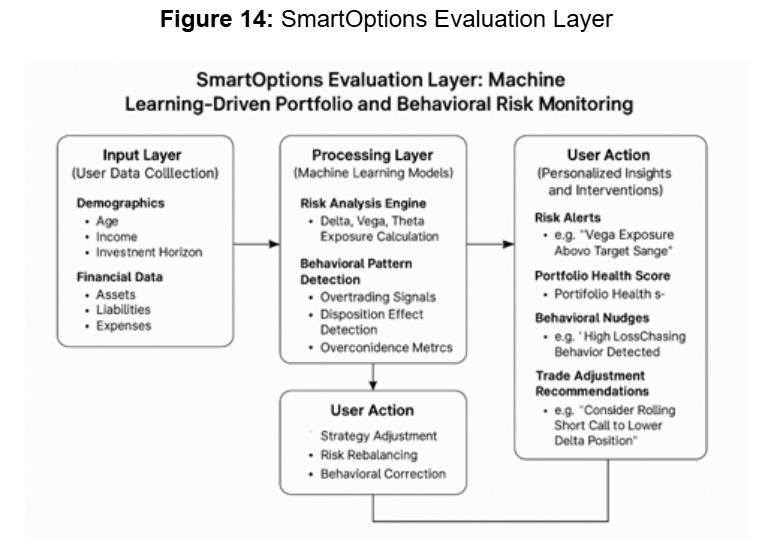
A core innovation of the Evaluation pillar is its integration of machine learning to enhance risk assessment and behavioral analysis. Through continuous monitoring, the platform evaluates how options trading impacts aggregate portfolio risk factors, such as Delta (directional exposure), Vega (volatility sensitivity), and Theta (time decay). Machine learning algorithms analyze evolving trade patterns, highlighting when user behaviors, such as excessive concentration in high-theta options jeopardizing long-term performance. Personalized feedback identifies when traders are deviating from their stated risk preferences or increasing systemic portfolio vulnerabilities.
This evaluation process is not purely quantitative. Drawing on behavioral finance literature (Shefrin & Statman, 1985; Barber & Odean, 2000), SmartOptions integrates behavioral coaching elements that surface emotional biases, such as the disposition effect or overconfidence, which often lead to suboptimal trading outcomes. By helping users link trade-by-trade decision-making to longer-term portfolio outcomes, the platform fosters disciplined behaviors that support sustainable wealth accumulation. Figure 14 outlines how personalized user actions are directly linked to both input layer and processing layer inputs in SmartOptions’ evaluation layer pillar.
Note. Adapted from OpenAI (2024)
By embedding continuous machine learning-driven evaluation into the trading lifecycle, SmartOptions fosters a disciplined trading environment where users not only optimize short-term execution but also maintain long-term portfolio health. This approach ensures that education and execution efforts culminate in resilient, goal-aligned financial outcomes. The Evaluation pillar thus transforms options trading from speculative short-termism into a strategic, sustainable component of comprehensive wealth building.
→ Continue Reading to Part 3: Market Analysis & Go-To-Market Strategy.