
Previous in this series:
- Part 1: The High-Stakes World of Retail Options Trading
- Part 2: SmartOptions’ Three Pillars
- Part 3: Market Analysis & Go-To-Market Strategy
- Part 4: MVP Prototype
- Part 5: Tech Stack & Go-To-Market Strategy
- Part 6: Competitor Analysis & User Studies
Data Requirements
Vendor Considerations
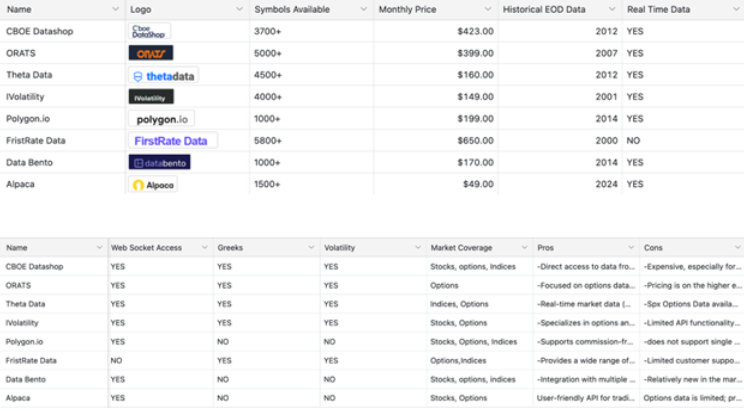
Careful consideration went into choosing the data vendor for SmartOptions’s financial product. Data requirements were needed to support the MVP demo, backtesting, and the live application. SmartOptions compared data vendors across the following categories:
- Market coverage: Vendors should provide access to a wide selection of security tickers with historical data going back at least five years. These option tickers should represent highly liquid stocks, ETFs, and indices. Unlike stocks, options data has the added complexity of incorporating multiple expirations and strikes per security, and it is important that this information is provided historically.
- Granularity: The resolution of the data retrieved for historical and real time data. Vendors can choose to provide various levels of data such as End of Day (EOD), Intraday, and Tick Level through APIs and Websocket access.
- Responsiveness: Vendors should provide an easy API interface with websocket access for real time streaming of live data. It is critical that a vendor’s API can be easily integrated providing for rapid latency for fetch requests for trade execution and updating the data in a timely manner.
- Depth of Fields: There are more than just Open High Low Close prices that can be provided. Some of the more notable and not always provided fields include Bid/Ask prices, open interest, implied volatility, and option greeks.
- Robustness: Vendors source their data differently, aggregating data from multiple exchanges and other vendors. To ensure high quality data that reflects the market’s true liquidity, it is critical for vendors to aggregate data from the most used exchanges (e.g. NASDAQ, CBOE, NYSE). This will ensure that all available trades and quotes have been processed, producing more accurate pricing in terms of bid/ask spreads.
- Price: Vendors offer solutions based on different tiered monthly and annual pricing based on capabilities provided (e.g. historical vs. realtime).
Vendor Comparisons
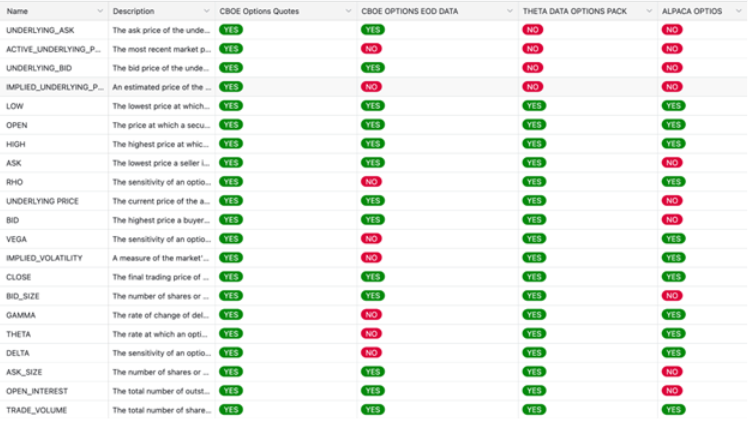
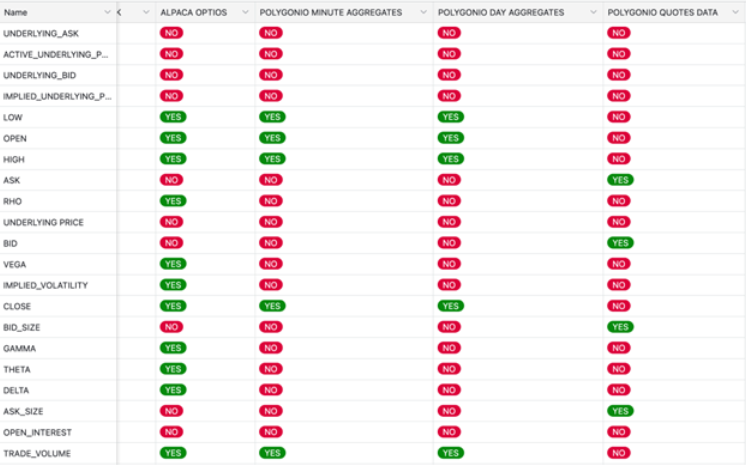
After analyzing the offerings of each data vendor (Appendix B), we narrowed down the top vendors based on quality and reputation comparing their capabilities. First, we compared each vendor’s depth of fields for “options quotes data” (refer to Appendix B – Quote Field Comparison). We found that CBOE was the most robust with ThetaData a close second, only missing underlying security information that’s not option specific. Polygon.io was lacking in options quote data so we removed this vendor from our selection search. Second, we compared each vendor’s depth of fields for “options trades data” (AppendixB – Trade Field Comparison). We found that ThetaData had the most relevant fields with missing fields lacking any significance.
We compared data samples from CBOE Datashop, Theta Data, and Polygon.io to assess field robustness and granularity (Appendix B – Vendor Data Samples). Theta Data offered the most granular (tick-level), affordable options data with broad historical and market coverage. While CBOE Datashop provides highly accurate, exchange-sourced data and broader asset coverage, its higher cost ($800 per ticker) and additional features weren’t enough to outweigh Theta Data’s value for our needs. Theta Data aggregates data from multiple exchanges with minimal delay, delivering millisecond-level tick data and real-time feeds suitable for most use cases, though with slightly less intraday precision. Commercial pricing would apply for live applications.
Theta Data MVP Dataset
Reviewing ThetaData’s API Documentation, we reviewed all of the different Rest APIs provided (Appendix B – Theta Data Rest APIs). We also organized the unique fields (data columns) from Theta Data’s Rest APIs (Appendix B – ThetaData Unique Fields). In order to copy and paste a historical trade and return the status of the position, we merged the following three Rest APIs from ThetaData: “Options: Bulk Historical Greeks” for position status, “Options: Bulk OHLC” for prices, and “Options: Bulk Quotes” for bid/ask details tracking. Theta Data has 3 types of historical data: EOD, Intraday (eg. 1hr, 30min, 1min) and then tick level which is in millisecond or seconds. There is also real time data for live feeds. We were able to bulk download and combined ThetaData’s three Rest API feeds, retrieving every minute P&L quotes from between the beginning and end data period for the contract while getting historical strike price, expiration, option type on any option trade.
Appendix B – Data Requirements
Vendor Breakdown
Quote Field Comparison
Regulatory Frameworks
SmartOptions is a fintech platform aimed at empowering retail investors with tools for smarter options trading. While our proposition of our platform is not to be a brokerage itself, we would bridge education and execution by connecting to users’ existing brokerages. This innovative model raises critical regulatory and legal considerations across multiple jurisdictions. In this section, we provide an in-depth analysis of five key areas our Capstone project addresses: (1) regulatory concerns in the U.S, (2) implications of integrating with brokerage platforms, (3) the feasibility of providing investment advice within legal bounds, (4) regulations impacting digital advertising and promotions, and (5) necessary legal agreements and user consent measures.
Regulatory Concerns
U.S. securities law defines a broker as any entity “engaged in the business of effecting transactions in securities for the account of others,” which requires registration with the SEC or FINRA oversight (U.S. Securities and Exchange Commission, 2021). SmartOptions will avoid broker-dealer status by limiting its role to delivering information and presenting a user-initiated interface, while relying entirely on the integrated brokerage for order execution. Under the Investment Advisers Act of 1940, providing individualized investment advice triggers registration as a registered investment adviser (RIA) (U.S. Securities and Exchange Commission, 2017). Although a “publisher’s exclusion” covers generic, impersonal materials, our platform’s tailored analytics and real-time alerts place it outside that safe harbor (Wilson Sonsini Goodrich & Rosati, n.d.). Accordingly, SmartOptions must choose between registering as an RIA or strictly confining its offerings to educational content accompanied by clear disclaimers.
Data privacy and security obligations apply whether or not we qualify as an RIA. If we register, Regulation S-P mandates safeguarding customer records and issuing privacy notices (U.S. Securities and Exchange Commission, 2021). Regardless, the FTC Act prohibits unfair or deceptive data practices, and state laws such as the California Consumer Privacy Act grant users rights to view, delete, and opt out of data sharing (State of California, Department of Justice – Office of the Attorney General, n.d.). SmartOptions will implement strong encryption in transit and at rest and establish transparent privacy disclosures to meet these requirements.
Implications of Brokerage Integration
Major brokerages maintain formal API programs that require third-party vendors to pass compliance reviews before granting access (Interactive Brokers, n.d.). SmartOptions will either secure approved-partner status or enable users to connect personal OAuth tokens, ensuring we remain at arm’s length from broker-dealer regulation. Handling sensitive account credentials and transaction data demands robust security, we will adopt token-based authentication, encrypt all data transmissions and stored information, and enforce multi-factor authentication. Pursuing SOC 2 or ISO 27001 certification will further demonstrate our commitment to cybersecurity (U.S. Securities and Exchange Commission, 2021). Because SmartOptions acts as a conduit for trade orders, our Terms of Service will clarify that users authorize SmartOptions to submit instructions on their behalf and retain ultimate responsibility for trades. We will require explicit confirmation for each order or an opt-in auto-execute feature that includes prominent risk disclosures. Our system will also respect any broker-imposed limits on margin or trading permissions.
Feasibility of Providing Investment Advice
To offer explicit trade recommendations such as “Buy a call on XYZ stock,” SmartOptions must register as an RIA, file Form ADV, and comply with fiduciary duties and record-keeping obligations (U.S. Securities and Exchange Commission, 2017). Adherence to SEC guidance for robo-advisers will require transparent algorithms, client risk profiling, and clear disclosures. Alternatively, SmartOptions can rely on the publisher’s exclusion by providing only impersonal analytics and educational materials without “you should” directives. However, our focus on personalized insights makes it difficult to avoid the adviser designation (Wilson Sonsini Goodrich & Rosati, n.d.). We will accompany any suggestions with unambiguous disclaimers such as “for informational purposes only” to set proper expectations. An education-first model offers a third path. By delivering simulations, backtesting tools, tutorials, and community forums, we empower users without delivering regulated advice. Labeling our role as a “trading coach” and pairing each insight with a clear risk warning will help maintain compliance while preserving user value.
Regulatory Impact on Digital Advertising
The FTC requires all advertising to be truthful, not misleading, and supported by objective evidence (Federal Trade Commission, n.d.). Claims of guaranteed profits or effortless gains are impermissible. Any testimonials must reflect typical user outcomes and disclose relevant limitations (USSFCU, n.d.). SmartOptions will include standard risk disclaimers such as “Options involve substantial risk; past performance is not indicative of future results.” If we register as an RIA, SEC Marketing Rule 206(4)-1 will govern our promotional activities. This rule prohibits misleading performance data, requires clear disclosures for endorsements, and mandates a minimum one-year performance period when showcasing returns (The New Framework for Investment Adviser Marketing, 2022). Finally, we will craft balanced messaging that presents benefits alongside risks and comply with platform-specific advertising policies. For example, Google Ads may require financial certification and specific disclaimers before allowing speculative trading promotions.
Key Outcomes and Paths Forward
SmartOptions should launch initially as an education and analytics platform to avoid licensing burdens, while planning for RIA registration when adding personalized advice. We will secure formal API agreements or enable user-owned tokens for brokerage integration and implement bank-grade security practices. To address advice regulations, we must choose between a full RIA compliance program or a strict educational scope supported by prominent disclaimers. In marketing, every communication will undergo legal review to ensure fairness and clarity. Finally, robust Terms of Service and Privacy Policies will include informative consent flows and user controls for data access and deletion. By systematically addressing broker-dealer and adviser registration, data privacy, secure brokerage integration, the permissible scope of advice, and truthful marketing, SmartOptions can transform regulatory compliance into a competitive advantage. This disciplined approach will build user trust, satisfy regulators, and support sustainable global growth.
Conclusion
The rise of retail options trading has exposed deep structural inefficiencies, misaligned incentives, and critical educational gaps in the financial markets. Ambitious but inexperienced retail traders face a fragmented, costly, and predatory environment that limits their potential for sustainable success. SmartOptions is uniquely positioned to address these systemic challenges by combining an educational resource, an advanced investing tool, and a user-friendly platform into one integrated experience. Built on the pillars of Education, Execution, and Evaluation, SmartOptions empowers users to make smarter, more informed trading decisions.
- Education is seamlessly embedded through gamified learning, real-time execution insights, personalized financial overlays, and interactive coaching. Unlike traditional platforms that offer isolated or static content, SmartOptions integrates dynamic, real-time education directly into the trading experience. Its Duolingo-style badge system acts as a personal trading coach, providing structure, feedback, and continuous guidance to foster expertise and disciplined financial behavior.
- Execution is powered by SmartEngine, a proprietary system that scans brokerages in real time to compress spreads, reduce hidden costs, and improve trade fills, ensuring users retain more value. By aligning incentives with user profitability through transparent, performance-based execution, SmartOptions builds trust and breaks away from the volume-driven, often opaque practices of legacy brokers.
- Evaluation closes the loop by offering detailed post-trade scorecards, trade replays, portfolio analysis, and risk insights, turning trading from a speculative gamble into a structured, learnable skill that helps traders thrive.
SmartOptions offers a scalable financial model built on two primary revenue streams: performance-based spread capture and tiered subscriptions. The platform projects reaching $1.25 billion in annual revenue by 2030 and $4.3 billion by 2033, fueled by expanding user adoption and deepening engagement. Where platforms like Robinhood have left retail traders exposed to institutional incentives and predatory practices, SmartOptions is built to lead a better path, helping traders reclaim the “dumb money” narrative and build lasting financial skills.