
Previous in this series:
- Part 1: The High-Stakes World of Retail Options Trading
- Part 2: SmartOptions’ Three Pillars
- Part 3: Market Analysis & Go-To-Market Strategy
- Part 4: MVP Prototype
- Part 5: Tech Stack & Go-To-Market Strategy
Competitor Analysis
SmartOptions’ competitors primarily focus on servicing one of three categories; 70% “Investing Tools” to help traders make more informed decisions, 16% “Educational Resources” focused on educational content, and 14% “Trading Platforms” focused on brokerage execution. This section will describe the major competitors in each category and how SmartOptions differentiation positions the company for success. A detailed overview of select competitors can be found in Appendix A.
Education Resources
The educational resource landscape for options trading is fragmented, spanning from institutional-grade platforms to community-driven learning hubs. CBOE’s Options Institute represents the high-end, offering structured training with proprietary data tools and corporate programs, catering to both professionals and retail traders. Platforms like Sheridan Risk Management target advanced traders through personalized mentoring and real-world strategy training, while OptionsTradingIQ provides a more accessible, retail-focused experience with practical strategy content. On the broader spectrum, Udemy offers mass-market, low-cost courses through a marketplace model, although with inconsistent quality and limited specialization in options trading. Bullish Bears blends affordability with community-led mentorship and live training for beginners and intermediates, focusing on psychological and technical trading skills. Together, these offerings illustrate a fragmented but growing market, balancing accessibility, expertise, and experiential learning (OpenAI, 2024).
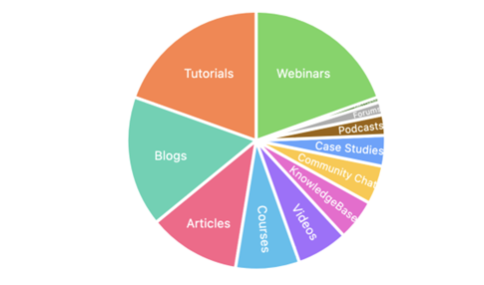
SmartOptions differentiates itself from the mostly isolated and traditional forms of educational content provided by its competition. Unlike competitive offerings, SmartOptions offers dynamic real-time education to learning options that is embedded into a user’s trading experience. SmartOptions takes a duolingo-style badge earning approach to options, acting as a user’s 1-1 coach who is always with them, guiding users toward expertise in options trading. Traditionally, educational content for options trading has been offered across less integrated and fragmented mainly digital categories:
FIGURE 31: Educational Content Offerings
Note: From SmartOptions Market Analysis, conducted April 2025 by the SmartOptions research team.
- Self-paced content: Tutorials (20%), blogs (16%), articles (11.5%), courses (8%), videos (6.5%), knowledgebase (5%)
- Interactive learning: webinars (20%), case studies (4%), podcasts (3%)
- Community and personalized support: community chat (5%), forums (1.5%), -on-1 coaching (.5%)
Investing Tools
The competitive landscape for options investing tools is diverse, ranging from advanced analytics platforms to AI-driven strategy builders, with some platforms offering brokerage integration for direct trade execution. Finviz and Koyfin stand out as equity research-centric platforms offering institutional-grade data visualization, market analysis, stock screening, customizable dashboards, financial statement analysis as well as backtesting for premium versions. Blackboxstocks and Levelfields.ai offer more advanced AI solutions, integrating unusual market activity scanning tools, real-time alerts, volatility indicators, and collaborative trading chat rooms. Levelfields.ai offers a unique value proposition through AI-driven event detection based off of a broad set of market-moving catalysts, such as earnings, economic releases, and geopolitical developments. OptionsAI and OptionStrat are tailored specifically for options trading, offering AI-driven tools that simplify strategy execution. OptionsAI stands out with smart trade suggestions and intuitive, probability-based visual strategy builders, while OptionStrat emphasizes ease of use with profit/loss simulations and unusual options flow tracking (OpenAI, 2024).
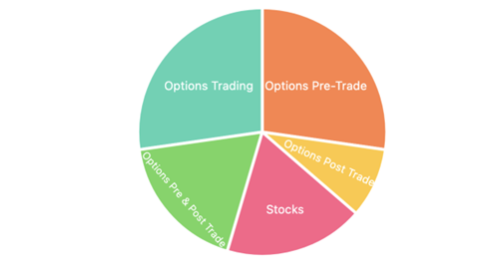
SmartOptions investing tools competition focuses on different stages of the trading lifecycle, with a good portion focused on mainly stocks not options. Specifically, 27% focus on pre-trade, 27% on live-trading, 18% on pre-trade & live-trading, 9% on post-trade, and 18% on stocks.
FIGURE 32: Investing Tool Trade Focus
Note: From SmartOptions Market Analysis, conducted April 2025 by the SmartOptions research team.
SmartOptions is uniquely positioned within the investing tools landscape by offering a comprehensive, integrated platform that goes far beyond traditional tools. Unlike most platforms that focus solely on specific stages (e.g. pre-trade), SmartOptions delivers a full-spectrum experience, emphasizing pre-trade setups, live-trade execution, and post-trade analysis. It combines a robust suite of existing tools with proprietary innovations to give users a 360-degree view of the many factors that drive trading decisions. These tools are not isolated features but deeply embedded into the platform’s educational framework, acting as a co-pilot throughout the trader’s journey to support smarter, more informed decision-making, recognizing that even one misstep can ripple across an entire portfolio.
Trading Platforms
The trading platform landscape is highly competitive, with firms differentiating themselves by features, pricing, target audiences, and trading tools. Fidelity Investments stands out as a well-established, full-service financial firm offering investment management, retirement solutions, and commission-free trading, supported by strong research tools and brand recognition. NinjaTrader appeals to active and professional traders with advanced charting while Robinhood targets younger retail traders with a mobile-first, commission-free platform that popularized fractional shares and low barriers to entry. Tastytrade combines brokerage and financial media, emphasizing high-probability options strategies with low trading fees and rich educational content, catering to experienced traders. ThinkorSwim, owned by Charles Schwab, offers professional-grade analytics and customization features, serving serious traders but also presenting a steep learning curve and limited crypto access. Interactive Brokers delivers global market access, ultra-low fees, and institutional-grade tools for both retail and professional clients, though it can be complex and cost-heavy for novices. Together, these platforms highlight the importance of innovation, usability, and specialization in appealing to the preferences of modern traders. (OpenAI, 2024)
SmartOptions is not positioned to compete directly with established brokerage giants like ThinkorSwim and Interactive Brokers, firms that generate revenue primarily from order flow, margin interest, and trading-related fees by facilitating the buying and selling of financial securities. These brokers typically focus on providing access to global markets, research tools, and execution infrastructure rather than delivering personalized investment advice. When investment guidance is offered, it’s usually through auxiliary services such as Registered Investment Advisors (RIAs) or automated portfolio builders. While many of these firms offer educational content, their core business is centered on driving trade volume, not on improving trading outcomes for their clients. In contrast, SmartOptions is built to help users become consistently more profitable traders. Rather than acting as a brokerage, it complements existing broker relationships by offering account linking, allowing users to execute trades through multiple brokers directly from the SmartOptions platform, while benefiting from tailored insights, strategy tools, and trader-focused education.
Competitive Advantage
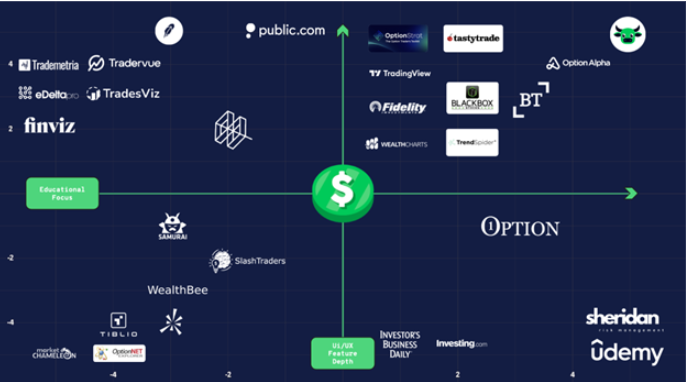
SmartOptions’s is uniquely positioned in the market as a combination of an educational resource, investing tool, and investing platform for options trading. Figure 33 below depicts the SmartOptions competition ranked by both education and feature usability and complexity. The X-Axis represents “Educational Focus” with -5 on the far left indicating very little to no focus on education and +5 on the far right indicating extensive or sole focus on education. The Y-Axis represents “UI/UX Feature Depth” where -5 on the lower bottom indicates poor UI/UX usability with limited feature capabilities and +5 on the upper top indicates rich UI/UX usability with robust feature capabilities. To illustrate this further, Finviz has no educational focus and basic UI/UX capabilities, positioning it in the left quadrant while Sheridan Risk Management only focuses on education with no UI/UX feature capabilities. SmartOptions stands out from its competition in the upper right corner being a platform that combines an educational focus with complex yet intuitive, user friendly features.
FIGURE 33: SmartOptions Competitive Advantage
Note: From SmartOptions Market Analysis, conducted April 2025 by the SmartOptions research team.
Additionally, a detailed breakdown comparison of SmartOptions’s differentiation across education, investing tools, and trading platforms is described here:
Table 9: SmartOptions Competitive Differentiation
| Category | Competitors’ Focus | SmartOptions’ Differentiation |
| Education Resources | – Fragmented educational landscape (e.g., CBOE Options Institute, Sheridan, Udemy, Bullish Bears)
– Primarily self-paced tutorials, articles, videos, and webinars – Community forums and occasional personalized coaching |
– Real-time dynamic education embedded into the trading experience
– Duolingo-style badge system for continuous engagement – Personalized, on-demand guidance integrated with actual trading decisions |
| Investing Tools | – Focus on specific trading stages (mostly pre-trade or live-trade) – Significant stock focus (18%) over options
– Examples: Finviz, Koyfin, Blackboxstocks, Levelfields.ai, OptionStrat, OptionsAI |
– Full-spectrum coverage: pre-trade, live-trade, post-trade
– Dedicated exclusively to options trading – Investing tools are integrated with educational content for smarter decision-making |
| Trading Platforms | – Execution-focused (e.g., ThinkorSwim, Interactive Brokers, Robinhood, Tastytrade)
– Revenue from order flow, margin interest, fees – Education and insights are secondary |
– Not a broker; complements brokerage accounts via trade linking
– Prioritizes improving client profitability through strategy, education, and analysis – Supports multi-broker connectivity for seamless execution |
Note: From SmartOptions Market Analysis, conducted April 2025 by the SmartOptions research team.
User Studies
Integration of Empirical Findings
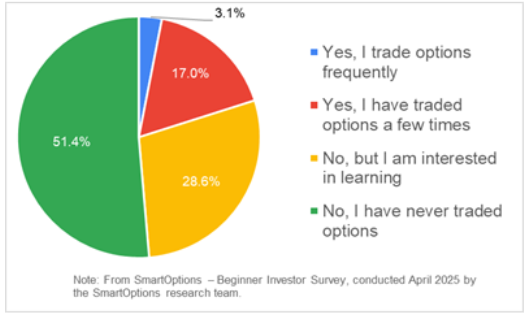
Our capstone SmartOptions team designed and deployed a “Beginner Investor Survey,” online, which provides a robust quantitative foundation that validates and informs our feature design choices. Over a two-week period, more than 300 voluntary, unpaid respondents completed our open, self-administered questionnaire. All participants provided informed consent and responses were collected anonymously to preserve confidentiality. The empirical insights derived from this survey not only reflect the challenges faced by novice options traders; for example, only 16 percent of respondents had ever invested in financial options and the average self-rated familiarity with options was just 2 out of 5, but also directly support the implementation of real-time alerts and the dynamic “Cone of Accuracy” visualization tools. Furthermore, the survey captured detailed feedback on the use of technological, educational, and operational platforms, ensuring that our recommendations address both usability and pedagogical gaps in existing solutions.
Profile of Experience and Real-Time Assistance Needs
Limited Operational Experience: Approximately 80% of respondents self-identify as having limited operational experience with options trading as shown in Figure 34. This lack of expertise highlights the critical need for support tools that simplify decision-making, particularly during periods of high market volatility.
Figure 34: Have you ever traded financial options?
Note: From SmartOptions Market Analysis, conducted April 2025 by the SmartOptions research team.
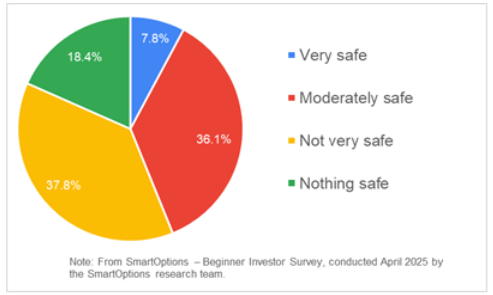
Challenges in Investment Decisions and Market Movements: Figure 35 shows that 55% of participants do not feel confident making investment decisions on their own, while survey data shows around 73% of participants reported significant difficulties in interpreting sudden market shifts and adjusting their strategies promptly. This insight justifies the inclusion of an automated alert system designed to notify users immediately when adverse market conditions or opportunities arise.
Figure 35: How confident do you feel making investment decisions on your own?
Note: From SmartOptions Market Analysis, conducted April 2025 by the SmartOptions research team.
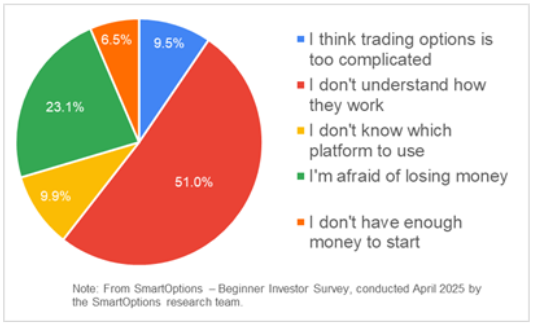
Financial Concerns and Uncertainty in Exit Strategies: Figure 36 highlights that 51% of participants don’t have much money to start trading while 23% fear losing money. Additionally, survey data shows nearly 68% of beginner investors expressed uncertainty regarding optimal exit points for their trades. The “Cone of Accuracy” visualization tool, which projects success probabilities based on dynamic risk and volatility metrics, directly addresses this issue by offering clear, actionable guidance for existing positions.
Figure 36: What is your main concern about options trading?
Note: From SmartOptions Market Analysis, conducted April 2025 by the SmartOptions research team.
Additional Insights and Relevant Correlations
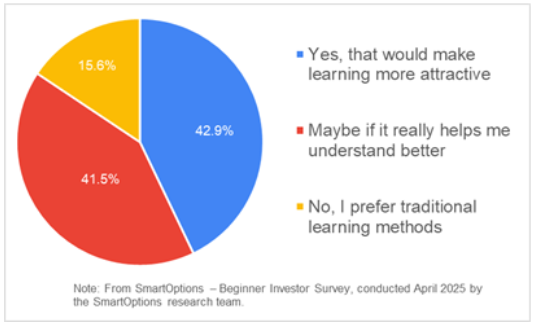
Gamification Interest: Figure 37 indicates that 85% of the surveyed investors expressed a strong interest in receiving gamified education for options trading as well as real-time advisory support, particularly during volatile market conditions. Moreover, a correlational analysis (r ≈ 0.55, p < 0.05) reveals that lower experience levels are significantly associated with a higher need for predictive support and timely notifications.
Figure 37: Would you be interested in learning how to trade options through a gamified system (levels, badges, interactive challenges)?
Note: From SmartOptions Market Analysis, conducted April 2025 by the SmartOptions research team.
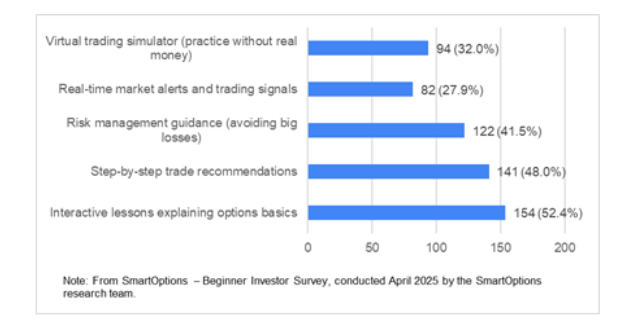
Demand for Predictive Tools: Survey results show that 52% of respondents prioritized interactive lessons on options basics, while 48% preferred step-by-step trade recommendations, highlighting a preference for foundational education over advanced tools like simulators and alerts. Additionally, survey data shows 75% emphasized the importance of visual, predictive tools for anticipating price movements and managing risk, supporting the integration of machine learning-driven features like the “Cone of Accuracy.”
Figure 38: What features would you find most useful in a beginner options platform? (Select up to 3)
Note: From SmartOptions Market Analysis, conducted April 2025 by the SmartOptions research team.
Impact on Risk Management and Educational Outcomes: An overwhelming 85% of novice traders reported that previous significant losses were linked to the absence of a defined exit strategy and delayed feedback. This finding not only supports the real-time alert system but also emphasizes the importance of interwoven educational modules that foster better risk management practices and facilitate continuous learning.
Implications for System Design and Future Iterations
Integrating these empirical insights from “Beginner Investor Survey” into the design framework of SmartOptions robustly supports the functionalities outlined. The evidence demonstrates that real-time alerts and predictive visualization tools are essential for assisting beginner investors, reducing uncertainty, improving risk management, and fostering a continuous learning environment. This data-driven approach significantly strengthens the platform’s potential to transform options trading, making it safer, more efficient, and more educational for novice traders.
→ Continue to Part 7: Data Infrastructure, Regulatory Compliance & Conclusion