
SAFe — the Scaled Agile Framework — is how large organizations try to solve a fundamental problem: getting hundreds or thousands of people building software to move in the same direction without drowning in process. Whether you’re prepping for certification, leading a transformation, or just trying to figure out why your organization is suddenly talking about “ARTs” and “PIs” in every meeting, this series breaks it down.
Part 1 covers the implementation roadmap and business agility — the “how do we actually start” and “why does this matter” questions. Part 2 gets into the Lean-Agile mindset and the ten principles that hold the whole framework together. Part 3 tackles execution: PI Planning, the Continuous Delivery Pipeline, portfolio management, and the full requirements hierarchy.
Let’s start with how you actually put this thing into practice.
The Implementation Roadmap
The SAFe Implementation Roadmap is the template for making SAFe real inside an organization. It’s not just a checklist — it’s a sequence that matters. Skip steps or do them out of order, and you’ll spend months fighting organizational gravity instead of working with it.
The roadmap serves two fundamental purposes: it establishes the urgency for change, and it builds the critical mass of informed, dedicated people needed to make the transformation stick.
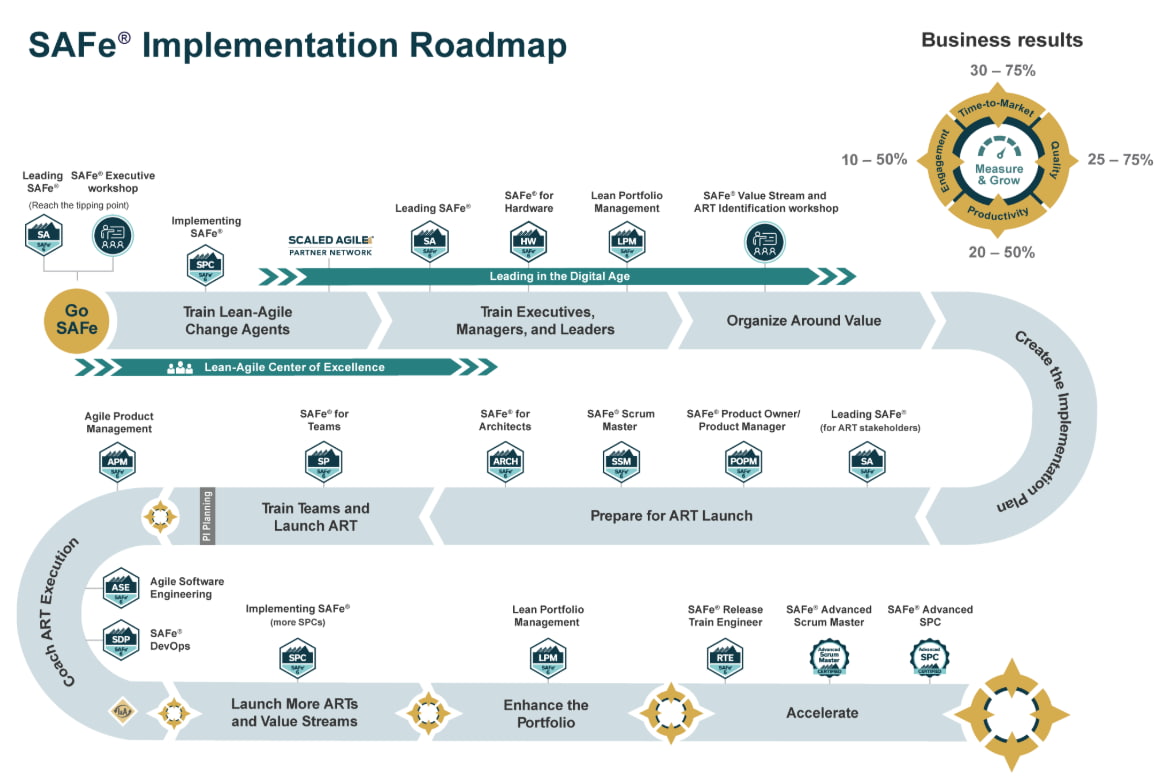
Notice in the diagram how the steps flow in a deliberate progression, with specific training courses mapped to each phase. This isn’t arbitrary — each step builds on what came before.
Step 1: Reaching the Tipping Point
Every SAFe transformation starts here — the moment when the organization decides that change isn’t optional anymore.
This tipping point gets triggered by one of two forces. The first is a “burning platform” — competitive pressure, market disruption, an existential threat that makes the status quo untenable. The second is visionary leadership that sees an opportunity to get ahead before the crisis hits.
The business case for SAFe centers on four measurable outcomes: 30-75% improvement in time-to-market, 25-75% improvement in quality, 10-50% productivity gains, and 20-50% increase in employee engagement. Without a clear articulation of why the change matters, everything that follows becomes an uphill battle.
Step 2: Train Lean-Agile Change Agents
Every transformation needs internal champions. In SAFe, these are the Certified SAFe Program Consultants (SPCs). They’re not external consultants who leave after six months — they’re your people, trained to guide the organization through the transition and sustain it afterward.
SPCs become the internal experts who can train others, coach teams, and troubleshoot implementation challenges. Without this dedicated capability, organizations find themselves dependent on expensive external help or struggling to maintain momentum after initial enthusiasm fades.
Step 3: Train Executives, Managers, and Leaders
Leadership has to sponsor and support the implementation, which means they need to understand it deeply. The Leading SAFe course is a two-day program designed specifically for this purpose.
But here’s what matters most: leaders must genuinely embrace Lean-Agile thinking — not just sign off on a budget line item. This isn’t about getting executive buy-in through a PowerPoint presentation. It’s about transforming how leaders think about work, value delivery, and organizational structure.
When executives don’t truly understand SAFe principles, they inevitably make decisions that undermine the transformation — approving projects that bypass the portfolio Kanban, demanding fixed scope with fixed dates, or reorganizing teams mid-PI.
Step 4: Create a Lean-Agile Center of Excellence (LACE)
The LACE is a working group that becomes the focal point for change management activities. It’s not a bureaucracy or an ivory tower — it’s an active, engaged team that drives the transformation forward.
Team size varies by organization: typically 4-6 people for an organization of around 300, scaling to 8-12 for around 600 people. Beyond that scale, you move to a hub-and-spoke model where a central LACE coordinates with satellite teams in different business units or geographies.
This is a frequently tested concept: LACE is part of the Agile Portfolio Operations dimension of Lean Portfolio Management.
Step 5: Identify Value Streams and ARTs
This is one of the most critical steps in the entire roadmap. Get this wrong, and everything downstream suffers.
Understanding Value Streams
Value streams are long-lived series of steps used to create value — from concept to the delivery of a tangible result for the customer. A simple way to visualize this: Ideas flow through Business, Dev, Test, and Ops until they become Value.
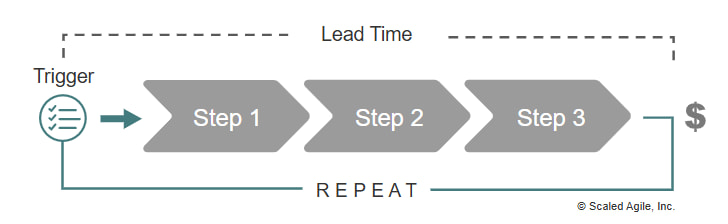
There are two types of value streams, and understanding the distinction is essential.
Operational Value Streams contain the steps and the people who deliver end-user value using the business solutions created by development. Think of this as the “run the business” stream — customer service handling requests, manufacturing producing goods, logistics delivering packages.
Development Value Streams contain the steps and the people who develop the business solutions used by operational value streams. This is the sequence of activities needed to convert a business hypothesis into a technology-enabled product or service. Deploying a new CRM system, building a mobile app, modernizing a legacy platform — these are development value streams.
The relationship between these two types is crucial: Development Value Streams support Operational Value Streams. Each Development Value Stream produces one or more Solutions that enable the Operational Value Stream.
Understanding Lead Time and Flow Efficiency
The time from the trigger (when work enters the system) to the delivery of value is the lead time. Shortening lead time reduces time to market. But here’s the insight that changes how you think about improvement: the easiest way to shorten lead time is to identify and reduce non-value-added activities and wasteful delays.
The fastest way to reduce time to market is to reduce delays — not to work faster.
Here’s a sobering example. If you deliver 6 hours of actual value-adding work over 7 weeks, your flow efficiency is roughly 2%. The other 98% is waiting. Work sits in queues waiting for approvals, handoffs, environment availability, or the next phase to begin.
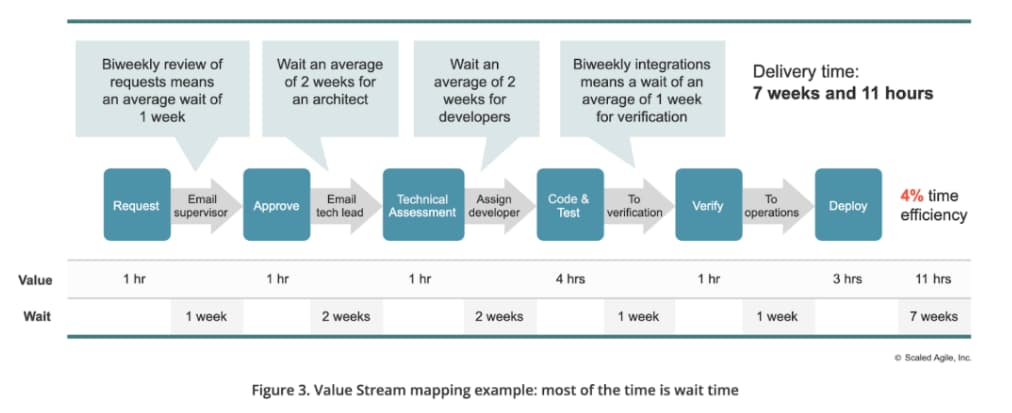
This value stream map makes it viscerally clear: 11 hours of actual work spread across 7 weeks. The vast majority of time is waiting. This is why reducing delays matters more than working faster.
Agile Release Trains (ARTs)
Once the development value streams are identified, the next step is to define the ARTs that realize the value. ARTs contain all the people and other assets needed to enhance the flow of value.
SAFe recommends that one Agile Release Train consists of 5-12 Agile teams, which translates to 50-125 people. This is a critical exam topic.
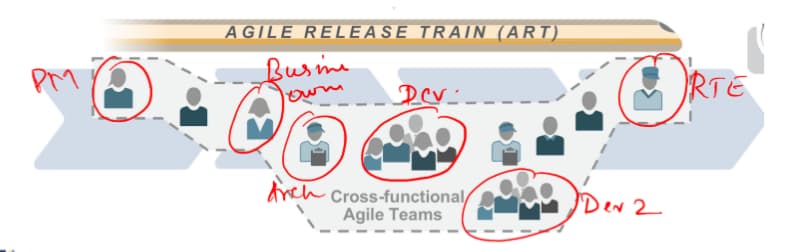
ARTs have specific characteristics that define them. They deliver Solutions, focused on a holistic solution or related set of products or services. They operate with the goal of achieving continuous flow of value. They synchronize on a common cadence. They align to a common mission through the ART Backlog. They are long-lived, stable teams that consistently deliver value. They minimize dependencies with other ARTs. They can release independent of other ARTs. And they track performance through the ART predictability report, which compares actual vs. planned business value.
A single ART can support one or multiple value stream solutions, while multiple ARTs can support a single large value stream solution. The mapping isn’t always one-to-one — it depends on the size and complexity of the solutions being delivered.
ART Topologies
Teams within an ART typically fall into four patterns, based on Team Topologies thinking.
Stream-aligned teams are organized around the flow of work and have the ability to deliver value directly to the customer. These are the primary value-delivery teams.
Complicated subsystem teams are organized around specific subsystems that require deep specialty skills. Think of teams focused on machine learning algorithms, real-time trading engines, or complex regulatory calculations.
Platform teams are organized around the development and support of platforms that provide services to other teams. They reduce cognitive load for stream-aligned teams by handling infrastructure, common services, and tooling.
Enabling teams are organized to assist other teams with specialized capabilities and help them become proficient in new technologies. They work across other teams to build capability, then move on.
ART Kanban
The ART Kanban illustrates the state of work as it flows through the continuous delivery pipeline. This visualization is essential for understanding where work is, identifying bottlenecks, and managing flow.
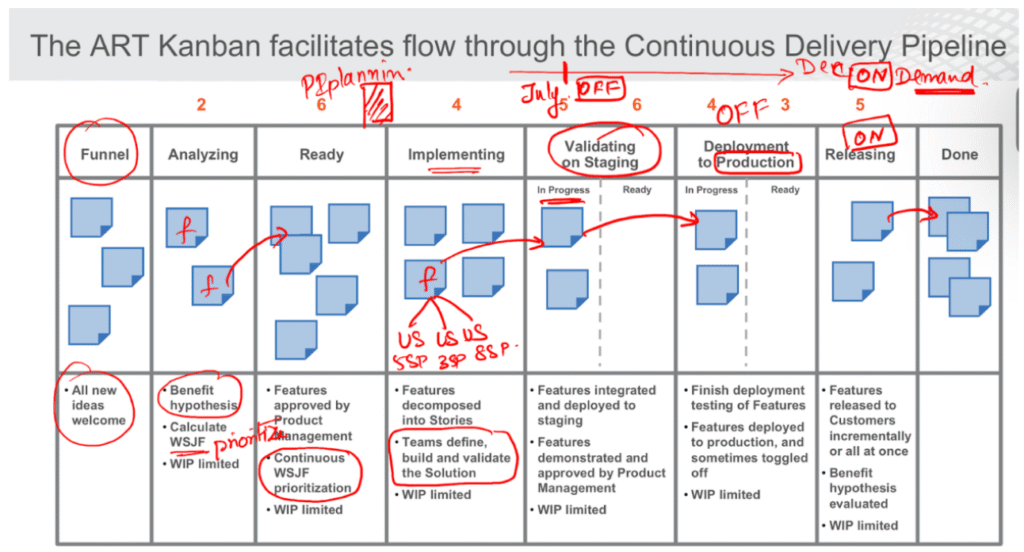
Notice that every state after the Funnel is WIP limited. This is a fundamental Kanban principle — limiting work in process improves flow, reduces context switching, and surfaces bottlenecks faster.
ART Events and Their Cadence
Understanding the rhythm of ART events is essential for certification exams. Each event has a specific frequency and duration:
- Scrum of Scrums (SOS): Once a week, 30-60 minutes
- PO Sync: Once a week, 30-60 minutes
- System Demo: At least once every two weeks, 30-60 minutes
- PI Planning Prep: Once a week, 30-60 minutes
- Inspect and Adapt: Once every PI, 3-4 hours
- PI Planning: Once every 10 weeks, 2 full days
These events create the heartbeat of the ART. Miss them or run them poorly, and the train starts to derail.
Step 6: Create the Implementation Plan
Here’s a counterintuitive insight from experienced SAFe practitioners: “The more detailed we made our plans, the longer our cycle times became.”
It’s far better to plan a bit, execute a bit, and learn a bit. The implementation plan uses tools like the Value Stream Canvas and PI Plans to guide the work, but doesn’t over-engineer the plan itself. The goal is to have enough structure to coordinate effectively while remaining adaptable to what you learn during implementation.
Step 7: Prepare for ART Launch
SPCs often lead the implementation of the initial ARTs, supported by SAFe-trained ART stakeholders and members of the LACE. Preparation involves multiple parallel workstreams: defining the ART using the Agile Release Train Canvas, setting the launch date and cadence, training ART leaders (RTE, Product Managers, System Architects), training stakeholders, establishing the Agile teams, and preparing the program backlog.
Each of these activities requires dedicated time and attention. Rushing the preparation phase leads to a rocky launch and months of remediation.
Step 8: Train Teams and Launch the ART
As different as it feels from traditional approaches, the all-in, big-room training approach remains a strong recommendation. It’s one of SAFe’s most cost-effective and valuable implementation strategies.
Getting everyone trained together, at the same time, creates shared understanding and momentum that’s hard to replicate with staggered or individual training. When 100+ people go through the experience together, they form connections, develop common vocabulary, and build the social network that will sustain the ART through challenges.
Step 9: Coach ART Execution
Once the ART is launched, coaching becomes essential. The ART doesn’t run itself — it needs active facilitation and continuous improvement.
Key coaching activities include iteration planning, backlog refinement, daily stand-ups, iteration reviews and system demos, iteration retrospectives, inspect and adapt workshops, and the various sync events (Scrum-of-Scrums, PO Sync, ART Sync) that maintain alignment across teams.
The Inspect & Adapt workshop deserves special mention. It’s a three-part event that includes the PI System Demo (review of what was built), Quantitative & Qualitative Measurement (retrospective data), and a Problem-solving workshop (addressing systemic issues).
Step 10: Launch More ARTs and Value Streams
The return on investment compounds as you scale: faster time-to-market, higher quality, higher productivity, and increased employee engagement. But scaling requires discipline and a systematic approach.
SAFe uses “The Four States of the Railway” to manage the transformation pipeline. This metaphor treats the transformation itself as a value stream to be managed.
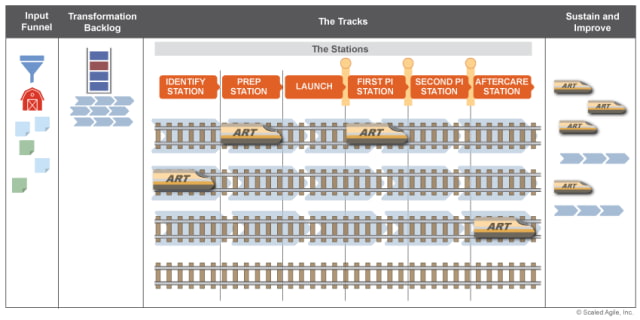
The Input Funnel has no WIP limits — this is where potential value streams wait to be transformed.
The Transformation Backlog is the to-do state, WIP limited to ensure adequate LACE and SPC support for each transformation in progress. Value streams stay here until they meet specific exit criteria: leadership prepared, ARTs identified, Development Value Stream Canvas defined, SPCs trained, coaching plan created.
The Tracks represent the doing state, where ARTs are structured, launched, and operated. The tracks are WIP limited in two ways: there are only a small number of tracks available, and there can be no more than a set number of trains on each track.
Sustain and Improve is where ARTs go once they can run independently, without constant attention from coaches. This state is not WIP limited — the goal is to get as many ARTs as possible to this self-sustaining state.
Step 11: Extend to the Portfolio
This is where you scale the transformation across the entire portfolio, connecting strategy to execution through Lean Portfolio Management.
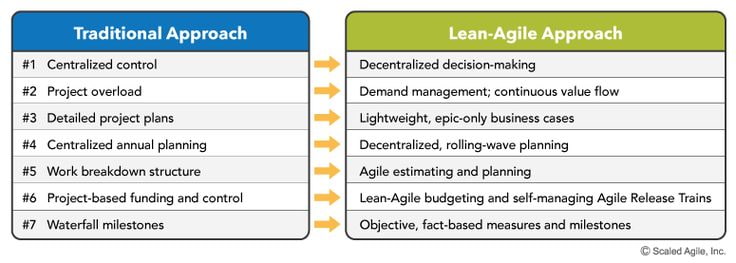
This table captures the fundamental mindset shifts required at the portfolio level. It’s not just about doing the same things faster — it’s about fundamentally changing how the organization thinks about planning, funding, and governance.
Step 12: Accelerate
The final step focuses on continuous improvement and scaling success across the enterprise.
Measure the performance of the portfolio using tools like the Spider Chart, which provides a visual assessment of maturity across multiple dimensions.
Reinforce the basics through the 10 Critical Success Factors of SAFe: Lean-Agile Principles & Real Agile Teams and Trains, Cadence and Synchronization & PI Planning, Customer Centricity, DevOps, Release on Demand, System Demo & Inspect and Adapt, IP Iteration & Architectural Runway, and Lean-Agile Leadership.
Progress toward mastery — transformation is never “done.” Anchor new behaviors in the culture. Apply learnings across the enterprise.
The Innovation and Planning (IP) Iteration
The IP Iteration deserves special attention because it’s often misunderstood and is frequently tested on certification exams.
The Innovation and Planning Iteration is a unique, dedicated iteration that occurs every PI. It provides an estimating buffer for meeting PI Objectives, dedicated time for innovation, time for continuing education, time for PI Planning itself, and time for the Inspect and Adapt event.
Without the IP Iteration, teams often find themselves with no slack in the system. Everything is scheduled to 100% capacity, which means any surprise or delay cascades into missed commitments. The IP Iteration provides a buffer that makes the overall system more predictable and sustainable.
Business Agility
SAFe is an operating system for business agility. The name itself — Scaled Agile Framework — tells you what it’s trying to achieve: applying agile principles at scale.
Business Agility is the ability to compete and thrive in the digital age by quickly responding to market changes and emerging opportunities with innovative, digitally-enabled business solutions. This isn’t optional anymore. It’s table stakes for survival.
The Dual Operating System
SAFe operates as a dual operating system, combining a value stream network with traditional hierarchy.
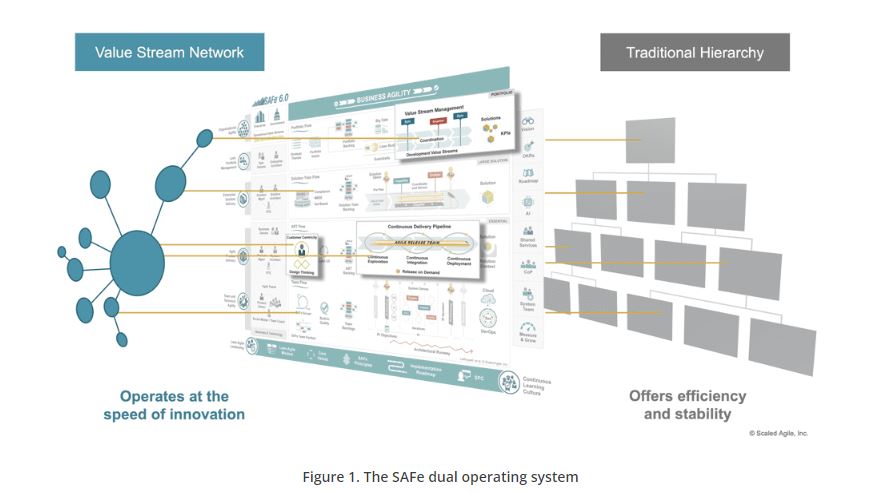
The value stream network is optimized for speed and adaptability — it’s where innovation happens, where products get built, where customer value gets delivered. The traditional hierarchy is optimized for efficiency and stability — it handles finance, legal, HR, and other functions that benefit from standardization and control.
SAFe doesn’t eliminate hierarchy. It augments hierarchy with a network that can sense and respond rapidly to market changes.
Seven Core Competencies
Business agility requires seven core competencies, all centered around Customer Centricity.
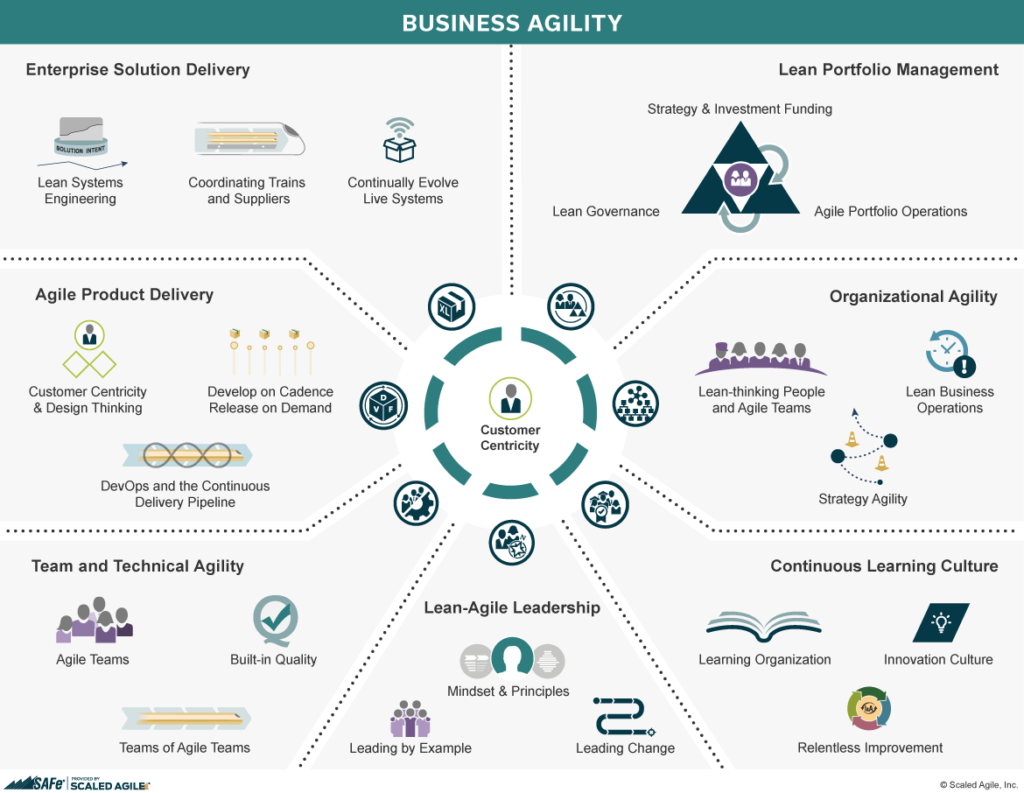
SAFe 6.0 places particular emphasis on three of these: Lean Portfolio Management (LPM), Lean-Agile Leadership (LAL), and Agile Product Delivery (APD).
Why Traditional Approaches Fail
The traditional approach to leveraging business opportunities is simply too slow. By the time you go through funding cycles, requirements gathering, design, implementation, and verification, 18-24 months have passed — and the opportunity may be gone or the competitive landscape may have shifted entirely.
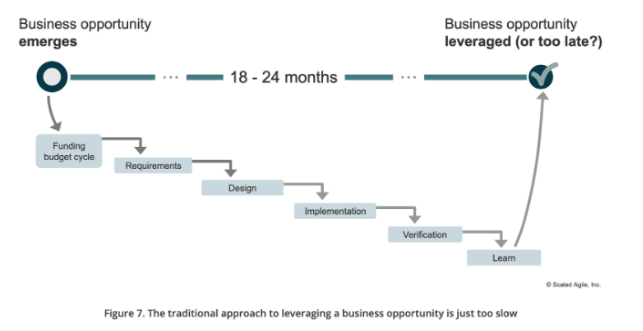
Instead, what’s needed is a rapid cycle of sensing and responding that helps the enterprise navigate the unknowns and arrive at a desirable solution before the window of opportunity closes.
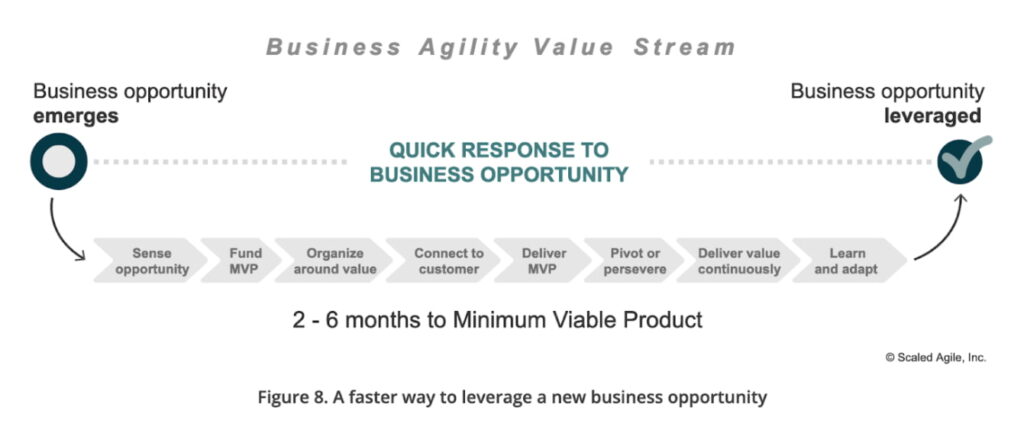
This compressed timeline — 2-6 months to MVP instead of 18-24 months to full solution — is what business agility enables. You don’t try to predict the future perfectly. You sense, respond, learn, and adapt.
Measurement
SAFe uses three categories of metrics to assess performance.
Flow metrics help determine how fast the value stream creates and delivers value: flow distribution, flow velocity, flow time, flow load, flow efficiency, and flow predictability.
Outcomes metrics help ensure the solution delivered benefits the customer and the business. Value stream KPIs measure things like customer satisfaction, revenue impact, cost reduction, and market share.
Competency measures evaluate organizational proficiency across the seven core competency areas and specific practices within each.
SAFe Core Values
Four core values underpin everything in SAFe.
Alignment means communicating the vision, mission, and strategy. It means connecting strategy to execution, speaking with common language, constantly checking for understanding, and understanding your customer.
Transparency means creating a trust-based environment. It means communicating directly, openly, and honestly. It means turning mistakes into learning moments, visualizing work, and providing ready access to needed information.
Respect for People means valuing diversity of people and opinions, growing people through coaching and mentoring, embracing “your customer is whoever consumes your work,” and building long-term partnerships based on mutual benefit.
Relentless Improvement means creating a constant sense of urgency, building a problem-solving culture, reflecting and adapting frequently, letting facts guide improvements, and providing time and space for innovation.
SAFe Organizational Overview
Before we dive into the Lean-Agile mindset in Part 2, it’s worth understanding how SAFe structures the organization. The framework operates at multiple levels with different time horizons and different roles responsible at each level.
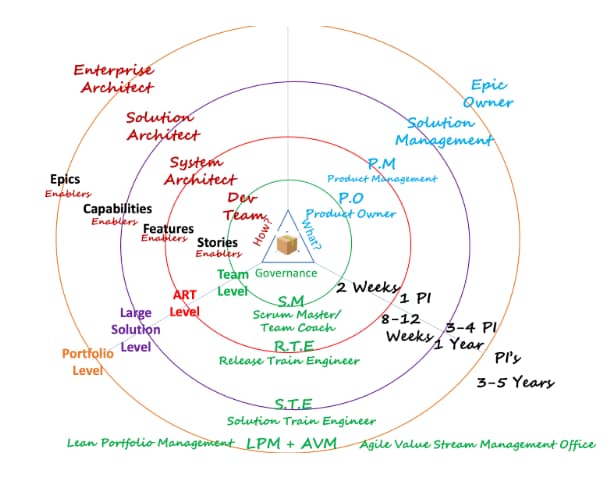
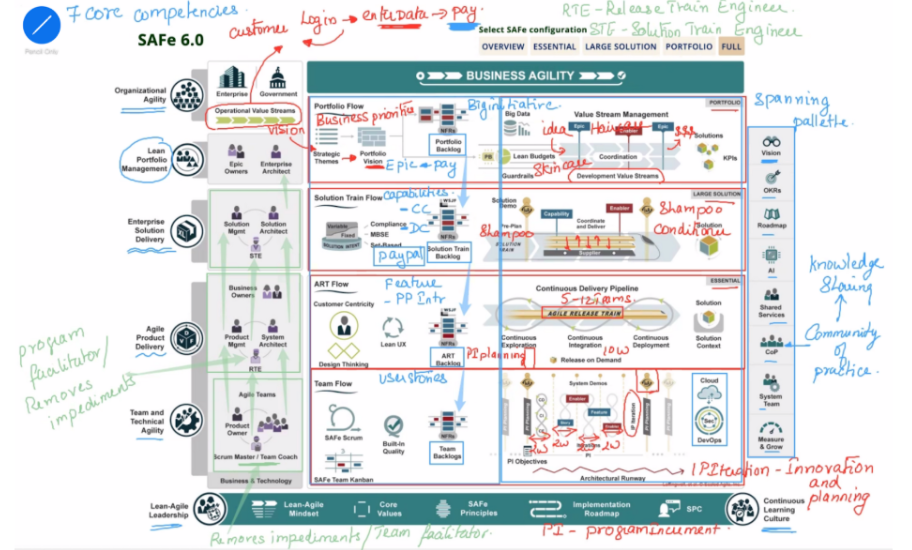
This diagram shows how everything connects — from strategic themes at the portfolio level down to user stories at the team level, with clear roles responsible for each layer. Notice the time horizons: teams work in 2-week iterations, ARTs operate on 8-12 week PIs, and the portfolio thinks in years.
What’s Next
In Part 2, we’ll get into the philosophy that makes SAFe work: the Lean-Agile mindset, the House of Lean, Kotter’s 8-Step Change Model, and all ten SAFe Lean-Agile Principles. These aren’t just theoretical concepts — they’re the foundation that every practice and artifact in SAFe is built on.
If you’re going to argue about SAFe (and people love to argue about SAFe), you should at least understand the principles it’s based on.