
Part 1 covered the mechanics – the 12-step implementation roadmap, value streams, ARTs, and what business agility actually looks like in practice. But mechanics without philosophy is just process theater. You can run all the ceremonies perfectly and still fail if the underlying thinking doesn’t change.
This part gets into the mindset that makes SAFe work: Lean thinking, the Agile Manifesto, the House of Lean, and the ten principles that every SAFe practice is built on. If you’re going to implement SAFe – or evaluate whether it makes sense for your organization – you need to understand what it’s actually trying to do at a deeper level.
The Lean-Agile Mindset
Applying Lean Thinking to product development means shifting from the traditional batch-and-queue production system to continuous flow with an effective pull by the customer. This shift can lead to dramatic improvements. The core focus: reduce waste.
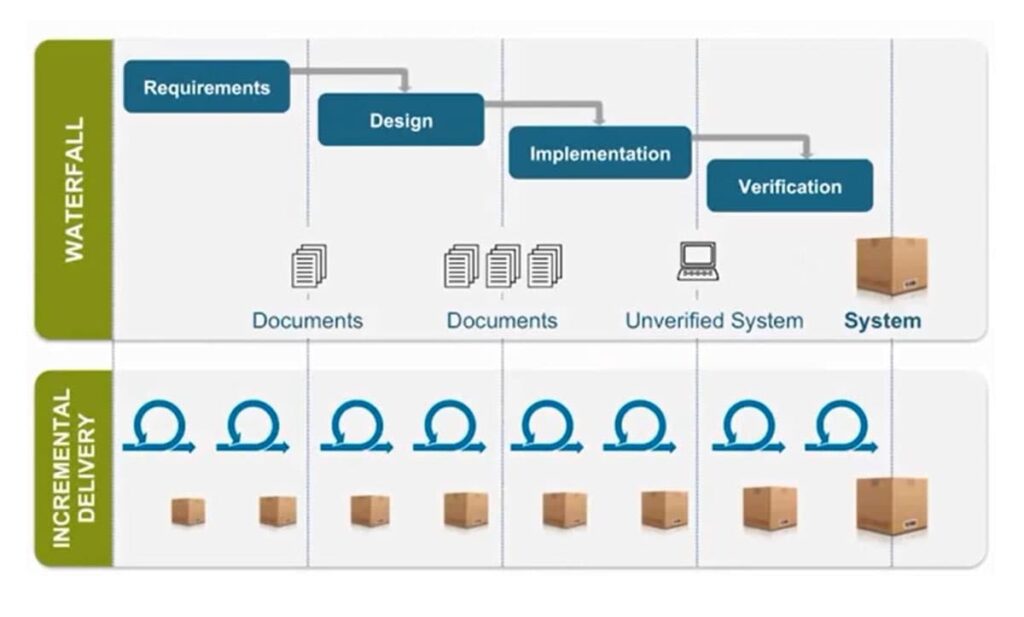
The shift from waterfall to agile isn’t just about shorter cycles. It’s a fundamentally different relationship with uncertainty. Waterfall assumes you can know enough upfront to plan the whole thing. Agile assumes you can’t — so you build in loops to learn and adjust.
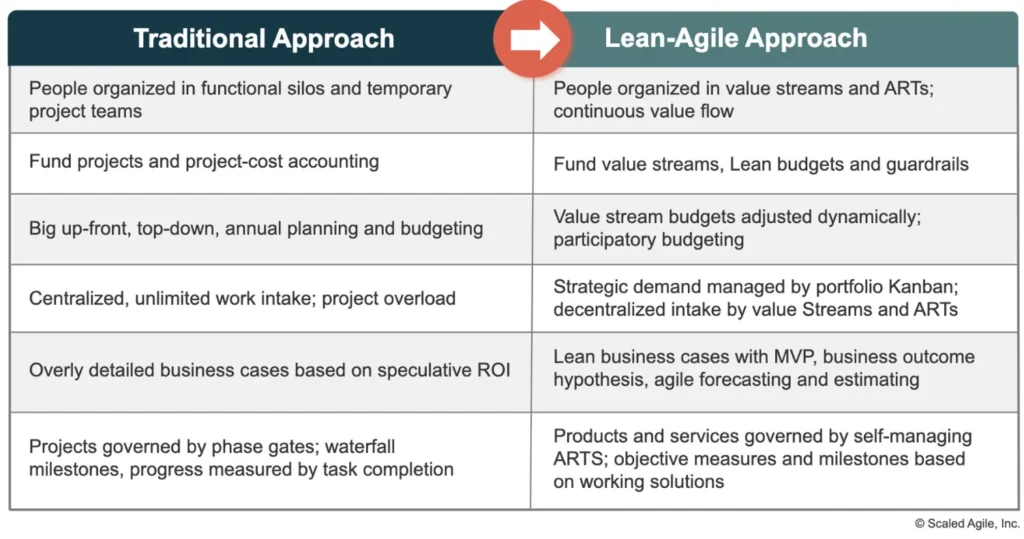
This comparison makes the shift concrete. It’s not just “be more agile” — it’s specific changes to how you organize, fund, plan, and govern work.
Lean Thinking Principles
Lean Thinking gives us five principles that apply to any value stream:
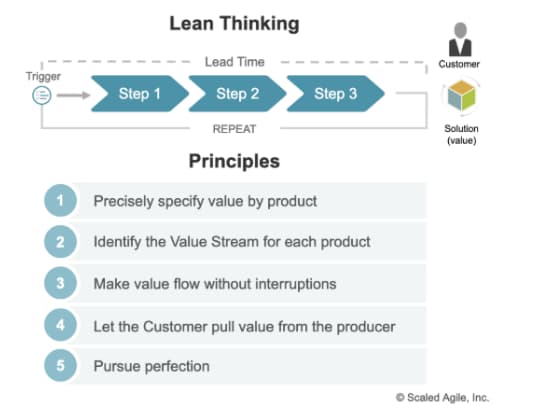
In Lean Thinking, “product” refers broadly to any service, solution, or value delivered. These five principles provide a systematic approach to improving any value stream — you specify what value means, map how it flows, remove interruptions, let demand pull work through the system, and never stop improving.
The Agile Manifesto
The Agile Manifesto establishes four value statements that still hold up more than two decades later:
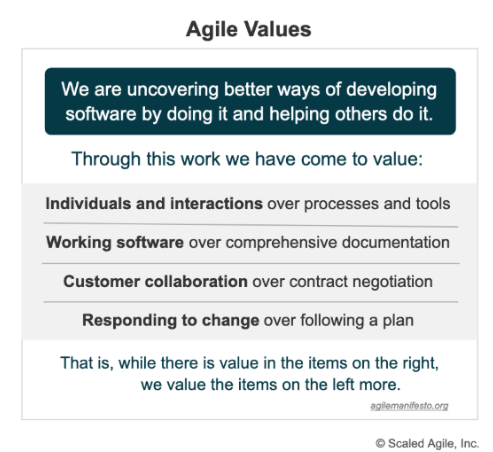
The nuance matters here. The items on the left are valued more, but the items on the right still have value. Agile doesn’t mean “no processes” or “no documentation.” It means prioritizing the human elements and working product over bureaucratic elements.
The 12 Agile Principles
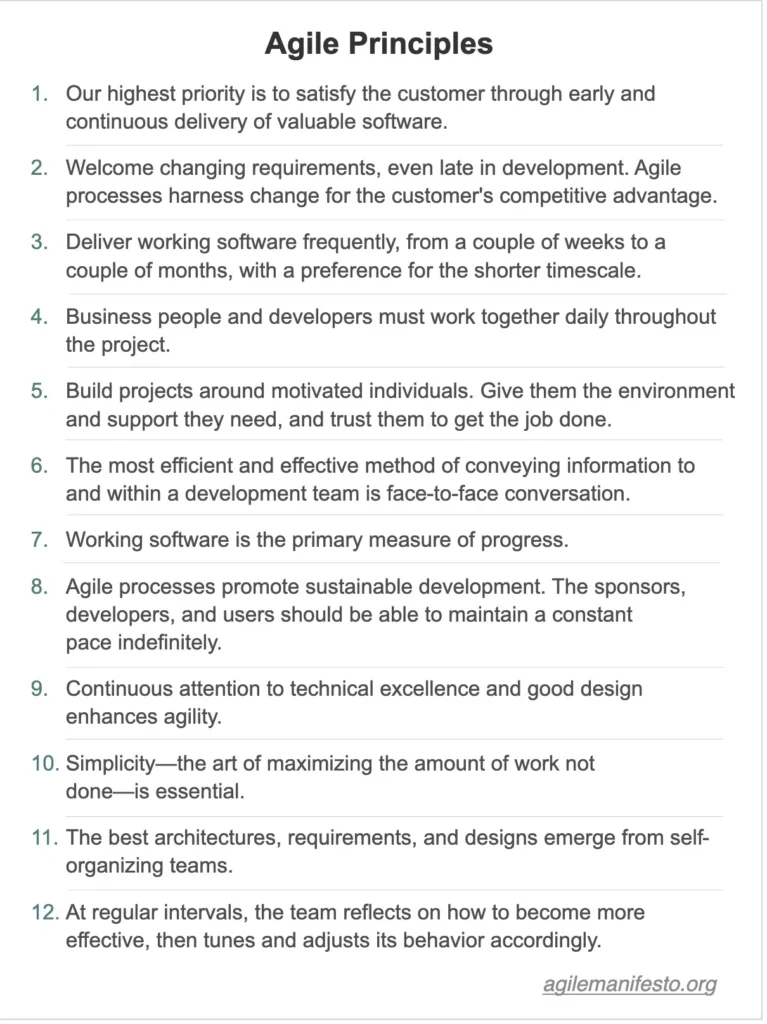
Several of these principles are particularly important for SAFe and frequently appear on certification exams.
Principle 4 states that business people and developers must work together daily throughout the project. In SAFe, the Product Owner represents business people in this ongoing collaboration.
Principle 5 says to build projects around motivated individuals, give them the environment and support they need, and trust them to get the job done. Freedom, autonomy, and mastery of work are the most important factors to motivate knowledge workers.
Principle 7 establishes that working software is the primary measure of progress. In SAFe, this is demonstrated through regular demos at both the team and ART levels.
Principle 12 says that at regular intervals, the team reflects on how to become more effective, then tunes and adjusts its behavior accordingly. This is implemented through retrospective events at multiple levels.
Lean-Agile Leadership
Lean-Agile Leaders drive and sustain organizational change by empowering individuals and teams to reach their highest potential. Their core responsibilities include:
- Organize and reorganize around value
- Identify queues and excess Work in Process (WIP)
- Continually focus on eliminating waste and delays
- Eliminate demotivating policies and procedures
- Inspire and motivate others
- Create a culture of relentless improvement
- Provide the space for teams to innovate
Three Dimensions of Leadership
Leading by Example: Model the behaviors you want to see. If you want teams to embrace transparency, be transparent yourself. If you want them to take risks, demonstrate that it’s safe to fail.
Mindset and Principles: Embrace and embody Lean-Agile thinking. This isn’t something you delegate — it’s something you live.
Leading Change: Drive transformation across the organization. This is critical and frequently tested: Establishing a sense of urgency is key to leading successful change.
Leadership Behaviors
The behaviors that distinguish effective Lean-Agile leaders include authenticity, emotional intelligence, life-long learning, growing others, and decentralized decision-making. These aren’t soft skills that are nice to have. They’re the foundation that makes everything else possible.
The House of Lean
The House of Lean is a conceptual framework that illustrates the goal, pillars, and foundation of Lean thinking.
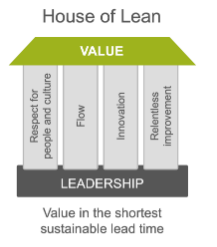
The Goal is to deliver Value — the shortest sustainable lead time, best quality and value to people and society, maximum customer delight at the lowest cost, with high morale and safety.
The Four Pillars are Respect for people and culture (the human foundation of Lean), Flow (making value move smoothly through the system), Innovation (creating new value and new ways of delivering value), and Relentless improvement (never being satisfied with current performance).
The Foundation is Leadership. Without engaged, committed leadership, the house collapses. This isn’t a nice-to-have — it’s structural.
The Core Principle: minimize delays, handoffs, and non-value-added activities. This is where Lean focuses its improvement energy.
Kaizen
Kaizen introduces the philosophy of continuous improvement. It’s not about big transformations — it’s about constant, incremental enhancement. The Japanese word literally means “change for better.” Agile adds structured practices like Scrum for effective management of this continuous improvement process.
Kotter’s 8-Step Change Model
John Kotter’s change model provides a framework for leading organizational transformation that aligns well with SAFe implementation:
- Create Urgency – Build a compelling case for change
- Form a Powerful Coalition – Assemble a group with enough power to lead the change
- Create a Vision for Change – Develop a clear vision and strategy
- Communicate the Vision – Share the vision frequently and powerfully
- Remove Obstacles – Eliminate barriers to change
- Create Short-Term Wins – Generate visible improvements quickly to build momentum
- Build on the Change – Use momentum to tackle bigger challenges
- Anchor Changes in Corporate Culture – Make it stick by embedding new behaviors in organizational norms
The parallel to SAFe’s implementation roadmap is intentional. Both recognize that successful transformation requires systematic attention to organizational change dynamics. You can’t just implement new processes — you have to transform how people think and work.
The 10 SAFe Lean-Agile Principles
These principles are the foundational tenets that inform SAFe roles, practices, and artifacts. They combine Lean thinking, Agile development, and product development flow principles into a coherent philosophy.
The 10 Principles are:
- Take an economic view
- Apply Systems Thinking
- Assume variability; preserve options
- Build incrementally with fast, integrated learning cycles
- Base milestones on objective evaluation of working systems
- Make value flow without interruptions
- Apply cadence, synchronize with cross-domain planning
- Unlock the intrinsic motivation of knowledge workers
- Decentralize decision-making
- Organize around value
Let’s examine each in detail.
Principle 1: Take an Economic View
Every decision should be informed by economics. Understand the economic framework — the cost of delay, the value of options, the trade-offs between different choices — and make decisions that deliver the best economic outcomes for the enterprise.
This isn’t about being cheap. It’s about being smart. Sometimes the economically optimal choice is to invest heavily. Sometimes it’s to cut losses quickly. The principle is to make these decisions consciously, with economic impact in mind.
Principle 2: Apply Systems Thinking
Systems thinking takes a holistic approach to solution development, incorporating all aspects of a system and its environment into design, development, deployment, and maintenance.
A critical insight: Only management can change the system. Individual contributors can optimize their own work, but systemic improvements require leadership action.
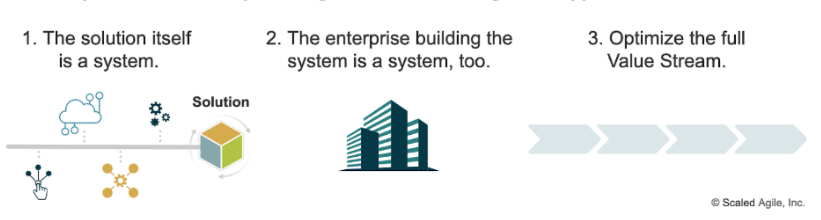
Fig: Three aspects of systems thinking
The Solution Is The System. Team members must clearly understand the system boundaries and how it interacts with the environment and the systems around it.
Optimizing a component of the system does not optimize the whole system. Components can become selfish and hog the resources — computing power, memory, electrical power, whatever — that other elements need.
For the system to behave well, teams must understand the intended behavior and architecture (how the components work together to accomplish the system’s aim). Intentional design is fundamental to systems thinking.
The value of a system passes through its interconnections. Those interfaces — and the dependencies they create — are critical to providing ultimate value. Continuous attention to those interfaces and interactions is vital.
A system can evolve no faster than its slowest integration point. The faster the full system can be integrated and evaluated, the quicker the system knowledge grows.
The Enterprise Building The System Is a System Too. Building complex systems is a social endeavor. Suppliers and customers are integral to the development value stream and must be treated as partners based on trust. Optimizing local teams or functional departments does not enhance the flow of value through the enterprise. The value passes through interfaces here too — which is why SAFe emphasizes cross-functional organizations like Agile Teams, ARTs, and Solution Trains.
Understand and Optimize the Full Development Value Stream. This is the only way to reduce the total time it takes to go from concept to cash.
One essential process is value stream mapping, a systematic way to view all the steps required to produce value. This makes waste visible and provides a baseline for improvement.
Principle 3: Assume Variability; Preserve Options
Traditional project management tries to lock down requirements early. This feels safe but actually increases risk — you’re betting everything on your initial assumptions being correct.
Set-based design — coupled with cadence-based learning milestones — produces better outcomes. Keep multiple options open as long as economically feasible. Let learning inform which options to pursue and which to abandon. The diagram shows how set-based design starts with multiple options and uses learning points to narrow down to the optimum solution, while point-based design commits early and struggles when reality diverges from assumptions.
Principle 4: Build Incrementally with Fast, Integrated Learning Cycles
This principle emphasizes “deliver early and often” — a frequently tested concept.
The goal is to increase learning efficiency by decreasing the time between action and effect. When you try something and quickly see the result, you learn faster. When there’s a long delay between action and feedback, learning is slow and expensive.
Reduce the cost of risk-taking by truncating unsuccessful paths quickly. If something isn’t working, find out fast and stop investing in it.
Small batch sizes facilitate this rapid learning. The iterative learning cycle follows the pattern: Plan → Do → Check → Adjust (the PDCA cycle).
Integration points reduce risk and accelerate learning. Examples include daily standups, iteration planning, system demos, and PI Planning. Each is an opportunity to integrate work, get feedback, and adjust course.
Principle 5: Base Milestones on Objective Evaluation of Working Systems
Traditional phase gates have significant problems: they force design decisions too early, assume a “point” solution can be built correctly the first time, create huge batches and long queues, and centralize requirements.
The solution is to replace phase-gates with milestones based on objective evaluation of working systems. PI System Demos deliver objective progress, product, and process metrics — real evidence of what’s been built and how well it’s working.
Enterprise metrics fall into three categories. Progress metrics show where teams are in delivering planned work (PI status, feature implementation status). Product metrics show current operational capability (functional and non-functional requirements, objective quality data). Process metrics show how well the system is performing (ART velocity, PI Predictability Measure, team self-assessments).
Principle 6: Make Value Flow Without Interruptions
SAFe identifies eight flow accelerators:
- Visualize and Limit WIP
- Address bottlenecks
- Minimize handoffs and dependencies
- Get faster feedback
- Work in smaller batches
- Reduce queue lengths
- Optimize time in “The Zone”
- Remediate legacy policies and practices
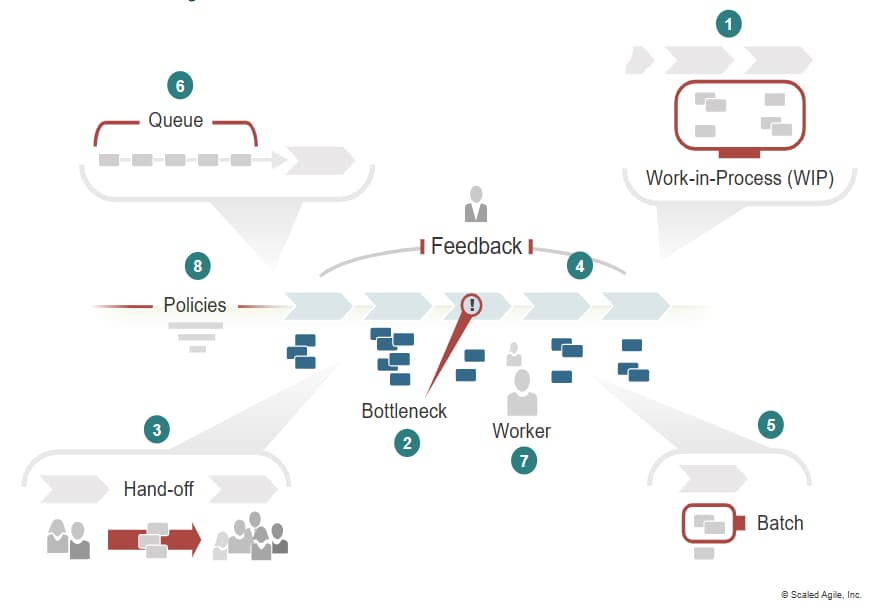
Three Primary Mechanisms for Implementing Flow:
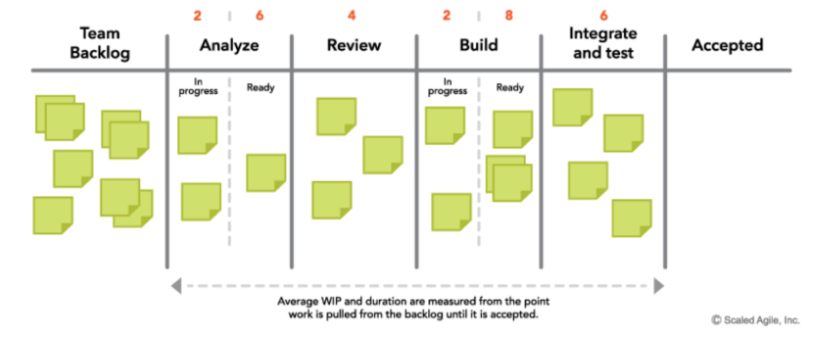
First, visualize and limit work in process (WIP). Make work visible and cap how much can be in progress at each stage.
Second, reduce the batch sizes of work items. Smaller batches flow faster and more predictably.
Third, manage queue lengths. No more than four items in a queue from a user story perspective.
Reduce Queue Length. The fastest method to reduce wait time is to reduce the queue length. Little’s Law states that average wait time equals the ratio of average queue length divided by average processing rate.
Here’s a practical example: if your average processing speed is 10 features per quarter and you have 30 features committed in the backlog, a new feature will experience an approximate wait time of 3 quarters. That’s a nine-month wait before work even starts on a new feature.
Tips for managing queues:
- Keep team and program backlogs short and largely uncommitted.
- Establish WIP limits for each process step.
- Be especially careful of large, long-term commitments.
The Importance of Small Batches
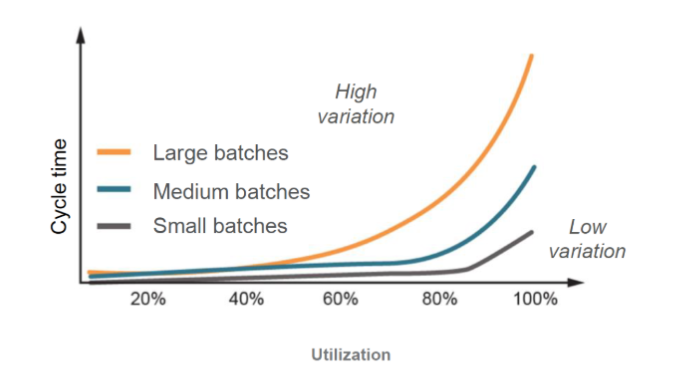
Fig: Cycle time vs. Utilization graph
Large batch sizes increase variability. High utilization also increases variability, resulting in project slippage. The graph shows how large batches combined with high utilization create explosive cycle times — the curve goes nearly vertical as you approach 100% utilization.
Small batches go through the system more quickly with lower variability. The most important batch to optimize is the hand-off batch — the work passed between people or teams.
Small batches go through the system more quickly and with less variability, which fosters faster learning.
Reducing Batch Size:
- Accelerates feedback
- Reduces rework (find problems earlier)
- Lowers cost (less invested before learning)
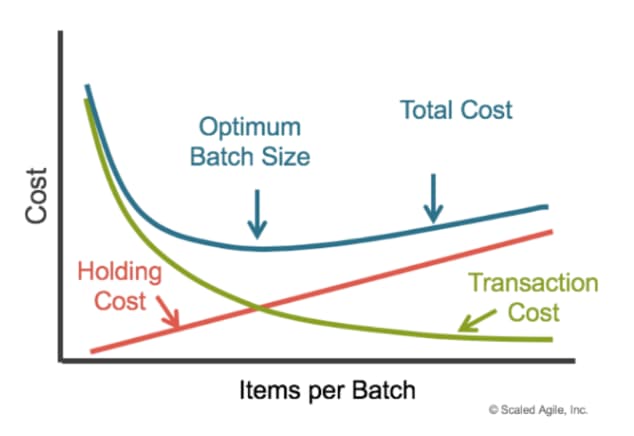
Fig: U-curve optimization for batch size
Holding cost is the cost of delayed feedback, inventory decay, and delayed value delivery. When work sits waiting, its value decays while the feedback it could provide is delayed.
Transaction cost is the cost of preparing and implementing the batch. This includes setup time, coordination overhead, and deployment complexity.
To improve the economics of handling smaller batches — and thus increase throughput — teams must focus on reducing the transaction costs of any batch. This is why investment in automation, tooling, and streamlined processes pays off — it makes small batches economically viable.
Principle 7: Apply Cadence, Synchronize with Cross-Domain Planning
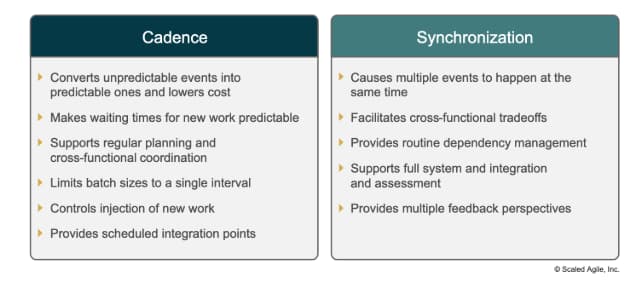
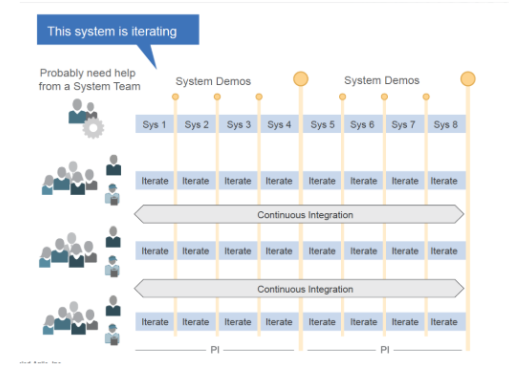
You need both cadence and synchronization. Cadence alone gives you predictability but not coordination. Synchronization alone gives you coordination but not predictability. Together, they create a system that’s both predictable and coordinated.
Aligning Development Cadence
Example: Having demo day be the same day for multiple teams. When everyone demonstrates on the same day, you can see how the pieces fit together.
Cadence-based planning limits variability to a single interval. You know that changes will be incorporated in the next iteration, the next PI, etc. — not randomly at any moment.
Synchronization with Cross-Domain Planning
Example: PI Planning. This is the opportunity for business and technical teams to be integrated and evaluated together at one time.
Cadence-based planning limits variability to a single interval with better management of variability by frequently revisiting and updating the plan.
ART Cadence Events
ART events create a closed-loop system to keep the train on the tracks:
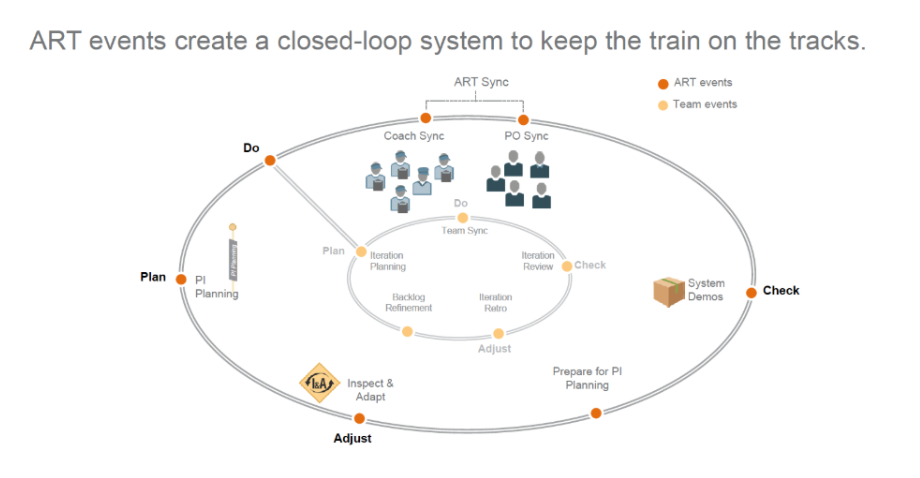
Coach Syncs, PO Syncs, System Demos, PI Planning, Inspect & Adapt, Performance measurement (Planned vs. Actual) — these events create the rhythm of the ART.
The PO Sync is a frequently tested concept. It’s attended by Product Owners and Product Managers and used for synchronization and coordination between them. The PO Sync provides visibility into ART progress toward PI Objectives, offers opportunity to assess scope adjustments, may be used to prepare for the next PI (sharing learnings from Continuous Exploration, ART backlog refinement, WSJF prioritization), is facilitated by the RTE or Product Management, and occurs weekly or more frequently for 30-60 minutes.
System Demos — Agile teams integrate their work and showcase the working solution increment at the System Demo. Key characteristics: features are functionally complete or toggled so as not to disrupt demonstrable functionality, new features work together and with existing functionality, demos occur after the Iteration Review, may lag by as much as one iteration maximum, and demo from a staging environment that resembles production.
Principle 8: Unlock the Intrinsic Motivation of Knowledge Workers
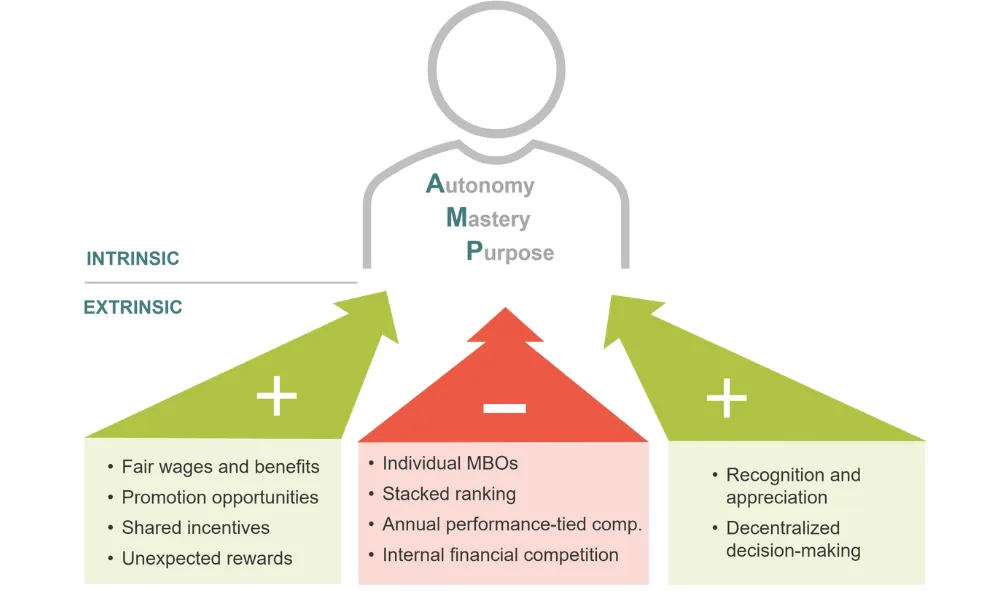
Fig: Intrinsic and Extrinsic motivation summary
Intrinsic motivation is the drive to perform an activity without any obvious external rewards. Knowledge workers pursue tasks because they’re enjoyable and interesting, not because of outside incentive or pressure.
Three Critical Intrinsic Motivation Factors:
Autonomy means leading with objectives not tasks, decentralizing decision-making, allocating time for self-directed exploratory work, and organizing around value.
Mastery means engaging in challenging activities and fostering learning from errors, leveraging unexpected rewards, building in quality, optimizing time “in the zone,” providing special assignments, and providing learning opportunities.
Purpose means connecting with the customer, providing mission and vision, bridging work to outcomes, leveraging synergistic goal-setting, and recognizing the team as a unit.
When using extrinsic motivation, prefer collective purpose over individual targets, appreciation and recognition over “if-then” incentives, collaboration over internal competition, and continuous feedback over annual performance reviews.
Principle 9: Decentralize Decision-Making
Decentralized decision-making delivers value in the shortest sustainable lead time, reduces delays (no escalation to higher authority), improves product development flow and throughput, facilitates faster feedback and more innovative solutions, and provides higher empowerment as an additional benefit.
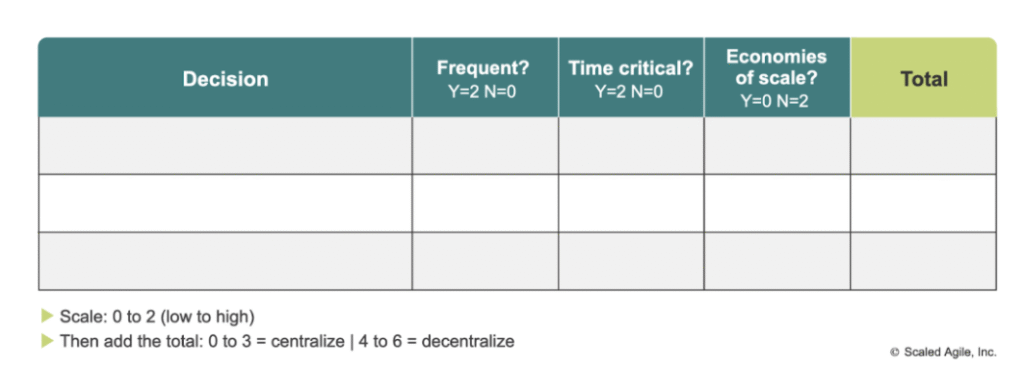
Decentralize decisions that are frequent, time critical, and require local information. Centralize decisions that are strategically important (deliver large and broad economic benefits), infrequent, long-lasting, and provide significant economies of scale.
Principle 10: Organize Around Value
Organize for one purpose: delivering value to the customer as quickly as possible.
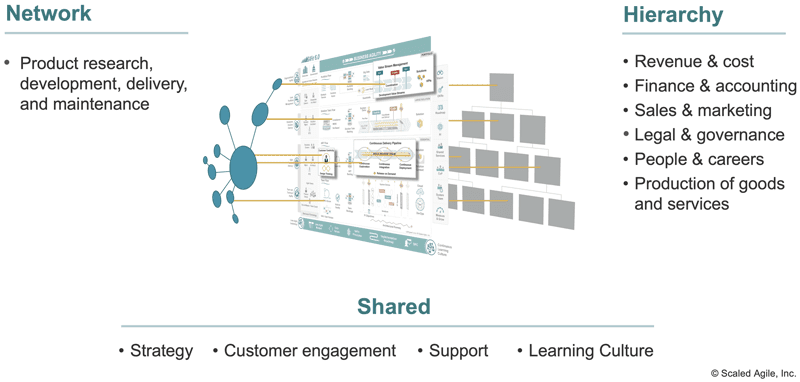
Fig: Dual operating system of Business Agility
Network is optimized for speed and adaptability – this is where value flows.
Hierarchy is optimized for efficiency and stability – this handles functions that benefit from standardization.
Reorganizing Around Value – Three Patterns:
Value Streams represent the series of steps an organization uses to deliver a product or service to a customer. They optimize the flow of value across divisions and functional departments.
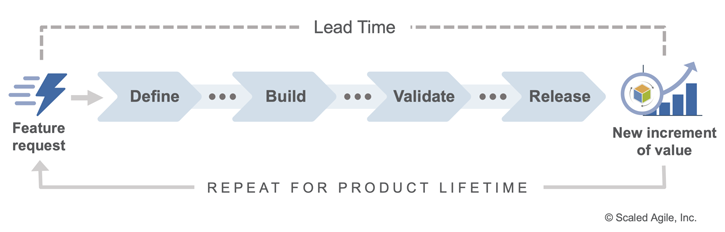
ARTs (Agile Release Trains) realize value streams with product-focused teams. They’re cross-functional teams of teams with 5-12 teams (50-125 people), synchronized around a common cadence, aligned to a common mission via a single ART backlog, and organized around development value streams.
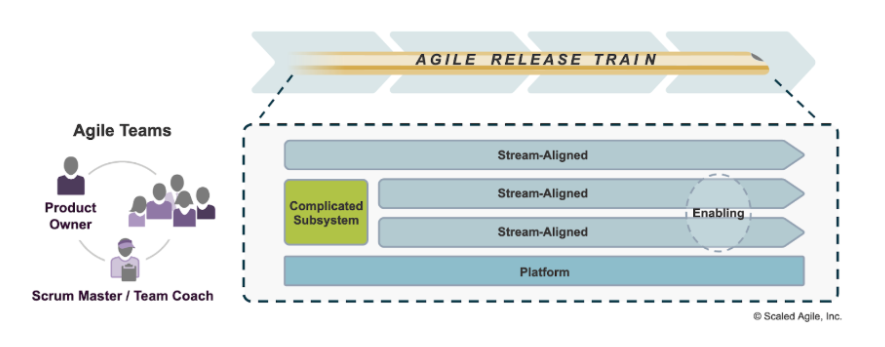
Fully Cross-Functional: ART Roles:
The Release Train Engineer (RTE) acts as the chief coach for the train, a servant leader who facilitates program execution, impediment removal, risk and dependency management, and continuous improvement. The RTE facilitates the Scrum of Scrums.
System Architect/Engineering provides architectural guidance and technical enablement, defines the overall architecture, works at a level of abstraction above teams and components, and defines NFRs, major system elements, subsystems, and interfaces.
Business Owners are key stakeholders with ultimate responsibility for business outcomes of the train.
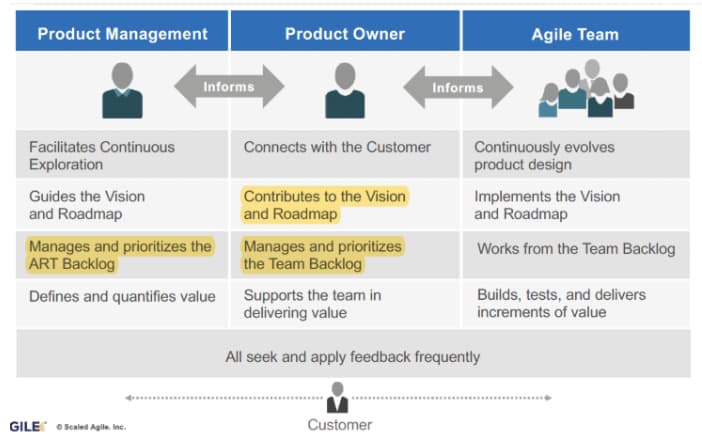
Product Managers own, define, and prioritize the ART Backlog, facilitate Continuous Exploration, create the Vision for the ART, guide the Vision and Roadmap, define and quantify value, and are responsible for “what gets built.”
Agile Teams are cross-functional and organized to deliver value, following the cycle Define → Build → Validate → Release. They use SAFe Scrum or SAFe Team Kanban, apply Built-in Quality practices, deliver value every iteration, and function as the basic building block of the SAFe enterprise.
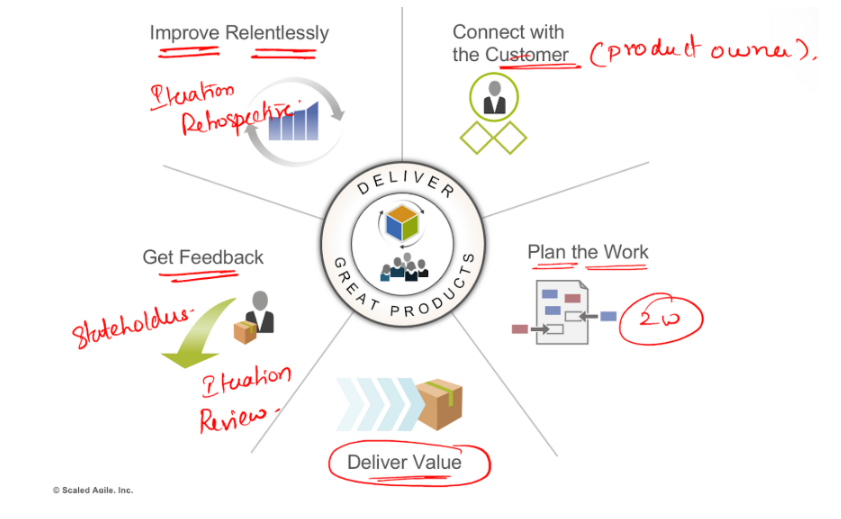
Scrum Master is the coach and facilitator at team level, responsible for improving ART performance, facilitating PI Planning, supporting iteration execution, improving flow, and building high-performing teams.
Product Owner is the voice of the customer for the Agile team and acts as the customer for developer requests. POs get and apply feedback, connect with customers, contribute to vision and roadmap, manage and prioritize the backlog, and support the team in delivering value.
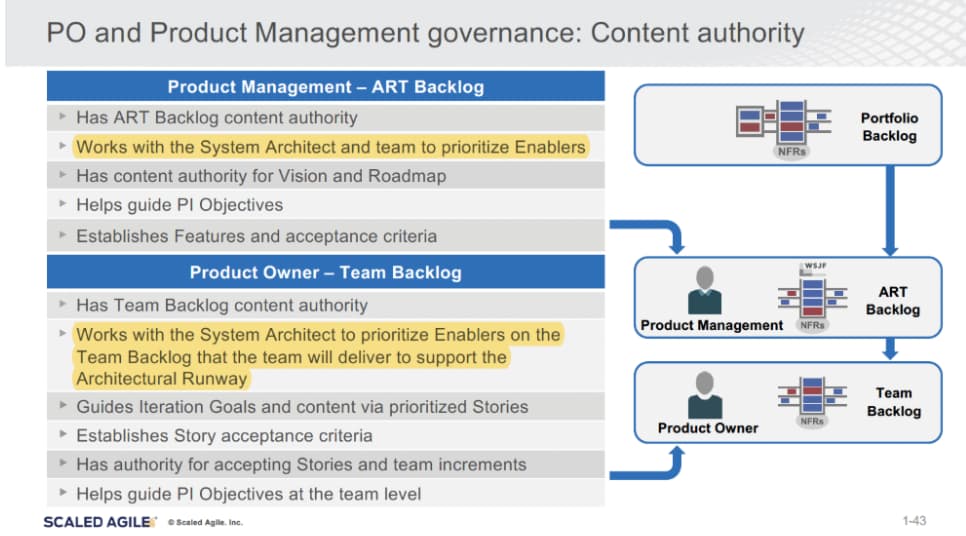
Content Authority: PO and Product Manager Governance
Understanding who owns what is critical for effective governance and is frequently tested.
What’s Next
Parts 1 and 2 covered the foundation — how to implement SAFe, what business agility means, and the principles that hold the whole thing together. In Part 3, we get into execution: how PI Planning actually works, the Continuous Delivery Pipeline, DevOps and CALMR, portfolio management with Strategic Themes and Lean Budget Guardrails, WSJF prioritization, and the complete requirements hierarchy from Epics down to Stories.
That’s where the framework meets reality.